It is that time of the year where the DNA results get updated again! It seems like just yesterday that AncestryDNA released an update, and yet, here we are again a year later! Let’s take a look at my updated AncestryDNA results and see how I feel about them. There are some new features and populations so let’s see how they compare with my results from 2024.
Background - 2024 Results
Source: “AncestryDNA Percentages”, Google Docs (Docs.Google.com : accessed 12 October 2025). Google Document created (6 Sep. 2022), maintained, and privately held by Luis Rivera.
Above are my results from October 2024, exactly one year ago when changes were made to my “DNA Origins”. You can see that new categories were added to my DNA while others basically disappeared. Therefore, let’s take a look at what happened this year with my results and what I think about them.
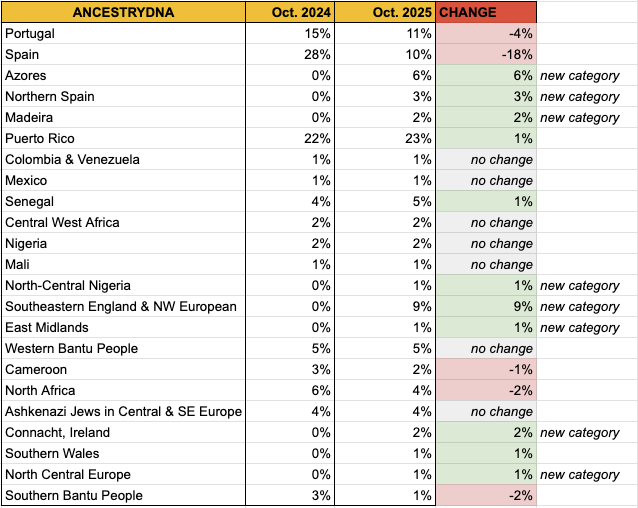
New Results - October 2025
Source: “AncestryDNA Percentages”, Google Docs (Docs.Google.com : accessed 12 October 2025). Google Document created (6 Sep. 2022), maintained, and privately held by Luis Rivera.
It was interesting to take a look at my new results in comparison to last year’s results. Looking at my results this time around, I thought that a lot had changed; however, looking at them with 2024 in mind I can see that the results or changes were not as drastic.
Granted, my Portuguese DNA continues to be high and my Spanish DNA dropped 18%; however, we can see that there are some new groups added such as Azores, Northern Spain, and Madeira that previously were not there which now account for 11% of my DNA. Similarly, it is interesting to note no changes in the categories of “Colombia & Venezuela” and “Mexico” which I figure might get absorbed into my Puerto Rican indigenous DNA in the future.
No new group drastically “stole” DNA from another category, besides maybe Southeastern England & Northwestern Europe which I am not sure where this is coming from (likely from old categories such as Denmark). Also, I now have Connacht, Ireland at 2%, despite having lost my Irish DNA in last year’s update.
Lastly, my Sephardic Jewish DNA which was at 1% in 2024 became just “Ashkenazi Jews in Central & Southeastern Europe” at 4%.
Why post about these results?
Some people might be wondering what’s the obsession with posting about these changes yearly? Especially since they will do just that again – change!
For me – taking a look at my DNA results and comparing them allows me to see where the companies are heading in terms of changes and updates. I have been using DNA testing since 2010-2011 and the changes have been very drastic to what they used to be back in the days. So seeing these yearly changes allow me to observe how populations come and go and how these companies are categorizing their results as new DNA population references come in.
Similarly, I come from a fairly mixed background. Despite my family being “Puerto Rican” for hundreds of years, there is a mix on the island. So far, I know I have ancestors from southern Spain, the Canary Islands, Mallorca, Guadeloupe, Martinique, Puerto Rico (indigenous Taíno) and Africa (likely west through slavery) – so taking a look at my results allows me to see how these mixes manifest themselves in my results. Similarly, it allows me to study my history and that of Puerto Rico through a very personal lens.
Some people might see this as a waste of time; however, there are people who similarly believe that genealogy is a waste of time and I fundamentally disagree with them. So I will continue to study my DNA and my family tree to better understand these changes and to understand what makes me… me!
I know that these results will likely change again in a year’s time and that the science is not perfect; however, it is important (to me) to see these changes in as real of time as possible. I definitely won’t go around saying I am 1% Mexican, but these smaller percentages make me question why they appear, if they are a manifestation of actual history in my DNA, and if not, how they will change or disappear in a year’s time. So here’s to the changes that are (hopefully) to come in 2026!
How have your DNA results changed?
1 thought on “A Puerto Rican Look at: AncestryDNA Update 2025”
CHEYENNE SAGE
My 3% Swedish vanished and my father’s went from zero to six!



My 3% Swedish vanished and my father’s went from zero to six!