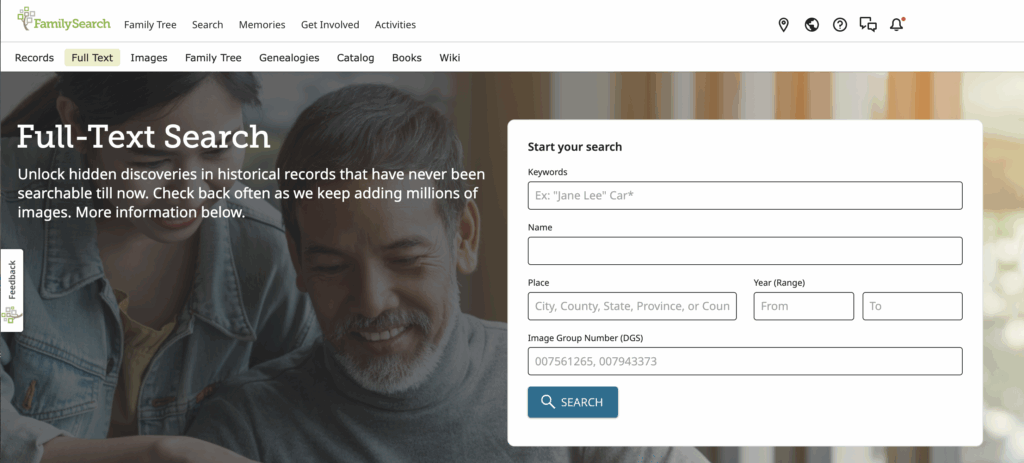
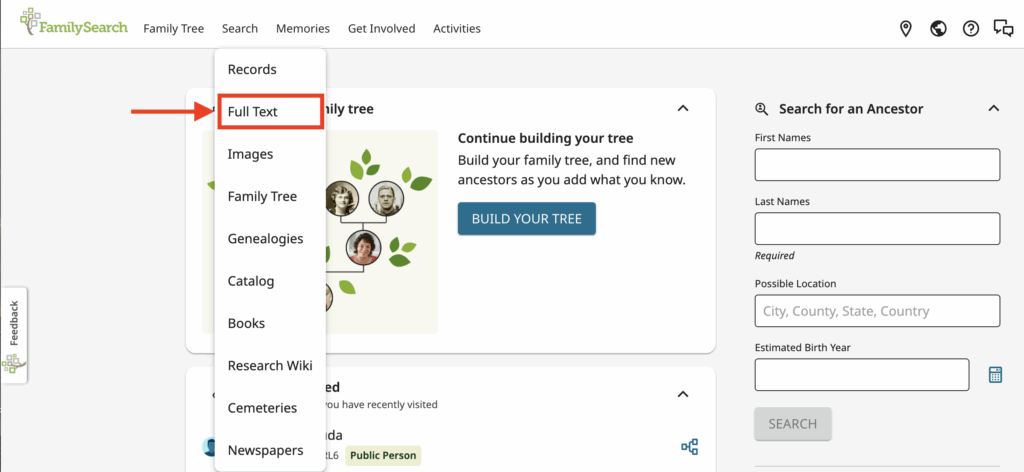
Recently, FamilySearch released their “Full Text” search option as an official tool on their website. Initially, I was hesitant that it would be useful for Puerto Rican genealogy; however, I was proven wrong this past weekend! So let’s take a look at this tool and how it can be used for Puerto Rican research.
Source: “Full Text Search,” FamilySearch (https://www.familysearch.org/en/search/full-text: accessed 16 September 2025).
What is Full Text Search?
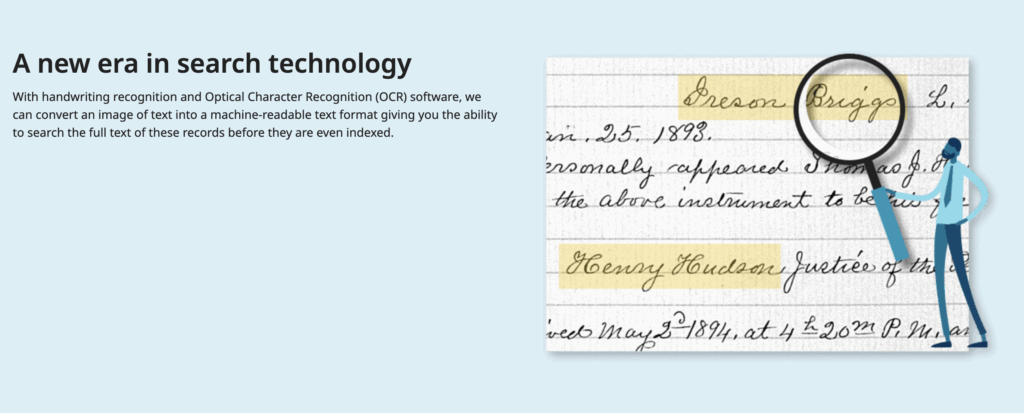
Full Text Search uses handwriting recognition and OCR (Optical Character Recognition) which can convert handwriting into machine readable text (FamilySearch). This means that it can take tons of documents and turn them into indexed searches – cutting out the time needed to read these documents. This is especially important for documents that do not follow a template but may contain important information regarding an ancestor. For example, a deed or probate record may include your ancestor’s name somewhere on the document; however, if you do not read the entire document you might not be able to find or recognize that your ancestor is listed in the document. This technology can also be helpful for documents that are lists that are pages long, allowing you to quickly search the document through an indexed search without having to read each individual name. In short, it saves a ton of time!
Source: “Full Text Search,” FamilySearch (https://www.familysearch.org/en/search/full-text: accessed 16 September 2025).
How can I use it in Puerto Rican Genealogy?
While the tool was in beta, I did not think (or at least did not realize) it had much use for Puerto Rican genealogists. As I mentioned, many of the records were probates, deeds, wills, etc. geared to the American (read: United States) genealogist. Over time though, more records from around the word began to get indexed and added to this searchable technology. Recently as the tool officially launched for all public use, I noticed that there were some collections for Puerto Rico that were now searchable!
Source: “Full Text Search,” FamilySearch (https://www.familysearch.org/en/search/full-text: accessed 16 September 2025).
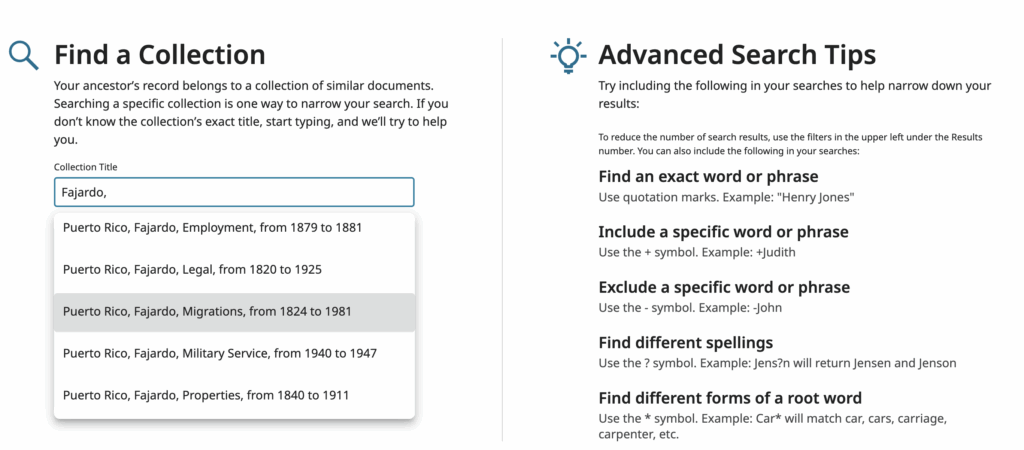
If you notice above, by searching for collections related to “Fajardo”, you can see that many of the collections listed are not your typical church or civil records that we as genealogists use for our Puerto Rican searches. There are records listed that are tied to employment, migration, properties, and even legal documents. I did not mention the military service documents because many of these are simply the World War II draft registration cards that you can already find on FamilySearch and Ancestry.
You can also just do a general search and limit the results to just Puerto Rico instead of a choosing a specific town and can also play around with the years or even spellings. Some search tips are included above.
Example of Findings
I was mainly interested in seeing if I could find some documents related to my 4th great-grandparents who arrived to Puerto Rico from Guadeloupe and Martinique, Gustave Jean Charles and Julienne Lautin. Though I have been able to piece a lot of their lives together through various documents, there is still much to learn about them. For example, when did they arrive to Puerto Rico? Did they arrive together? I know that spent sometime in Martinique since their daughter was born there – When did they leave and return to Puerto Rico?
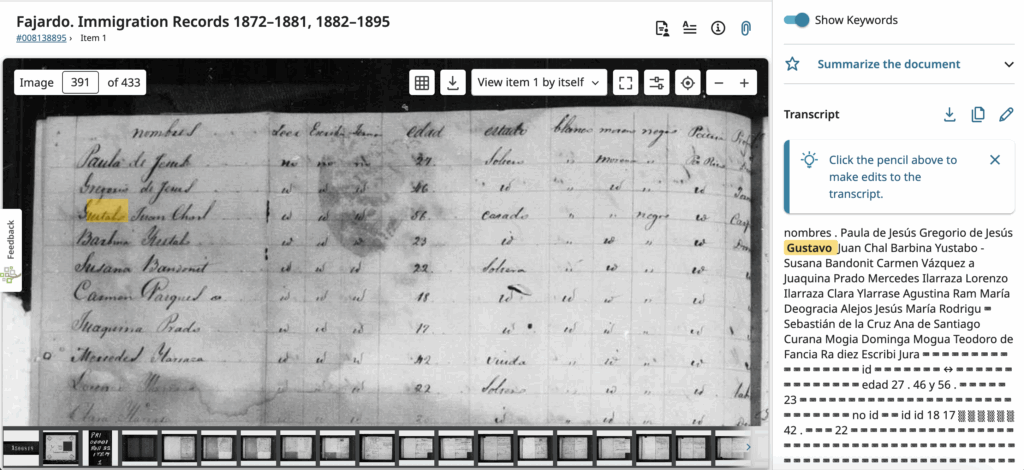
Using Gustave’s name, I was able to use the Full Text search tool and find some documents related to my ancestors. From the result below, you can see that the Full Text search picked up on “Gustavo” though written as “Gustabo”.
Archivo Histórico del Municipio de Fajardo, Puerto Rico, “Cédulas Personales y de Vecindad, 1872-1881,” lines no. 3-4, Gustabo Juan Charles and Barbina Gustavo; FamilySearch (https://www.familysearch.org/: accessed 16 September 2025), DGS no. 8138895, image 391 of 433.
Above you can see Gustavo Juan Charl [Charles] and Barbina Gustavo – my 4th great-grandparents. Gustavo was listed as unable to read, write, or sign his name, 56 years old, married, black, Puerto Rican, and a carpenter. His wife Barbina was listed as also being unable to read, write, or sign her name, 23 years old, married, black, Puerto Rican, and a homemaker. Flipping a few pages back I could see that this document was from the barrio (neighborhood) of Sardinera in Fajardo and was a list of “relación de los individuos a quienes se le expiden cédulas de vecindad represando sus condiciones, estado, clase” (List of individuals to whom neighborhood cards are issued, reflecting their conditions, status, class). Back on the page where Gustavo and Barbina (should be Balbina, a nickname it seems my 4th great-grandmother used, possibly a misheard version of Malvina, her middle name) appeared, the year 1873 is scribbled on the bottom of the page.
Without the Full Text search, I would have never found this entry, let alone know that this record set existed online! From this document I can firmly place my ancestors in Sardinera, Fajardo, Puerto Rico in 1873 and I can learn and confirm more details about them – that they were unable to write and that they were classified as negros (black). Though I knew some of this information from other records, here we can see them directly classified as this.
What's Next...?
I am hoping more records from Puerto Rico get added to this Full Text Search option over time. This will help us to quickly search records for our ancestors without having to go page-by-page looking for them. Granted, the technology isn’t perfect and so sometimes it cannot pick up correctly on the handwriting, but I know that everyday this technology is getting better and better.
I have noticed that there are other records tied to drivers licenses, school teachers, and other town’s census and resident lists. I can’t wait to see what else I can find!