
Recently, I decided to add three of my grandmother’s siblings to 23andMe. Though 23andMe does not feel as strong of a genealogical community as it did in the past, it still remains, in my opinion, to be one of the best ethnicity predictors out there. My main wish is that they bring back the chromosome browser that allowed you to see exactly where you matched with genetic cousins on your chromosomes. I am hopeful that the community will bring back this important to tool genealogists.
With a recent sale in the winter, I decided to ask my grandmother’s siblings to test and they all agreed. Slowly in early 2025 their results began to trickle in. One particular feature of their DNA was consistent and super interesting – one of the genetic communities they all shared that was not expected. This was the Delmarva Peninsula African American genetic group. Since my family is from Puerto Rico, this was surprise to me to say the least! So I wanted to explore this a bit in this post.
Delmarva Peninsula
African Americans

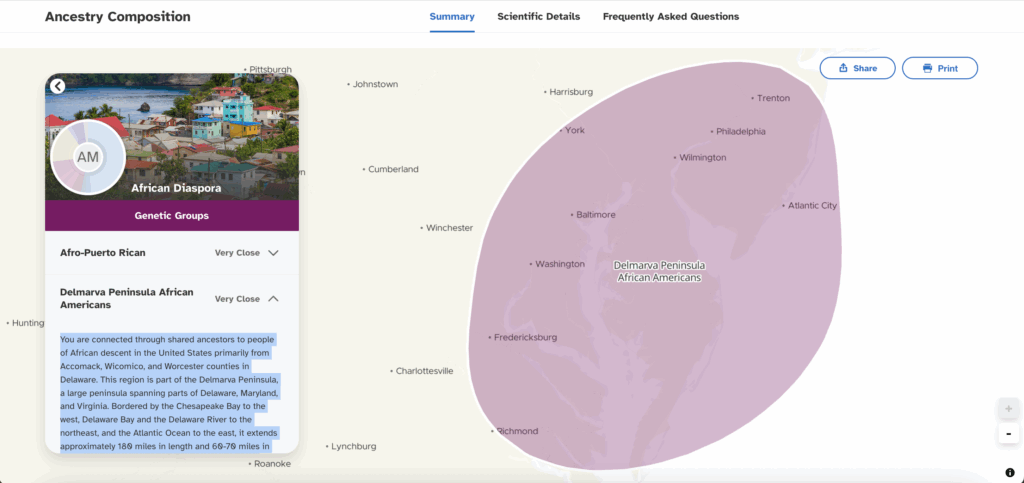
As you can see there are two groups under the African Diaspora – Afro-Puerto Ricans and Delmarva Peninsula African Americans. The former was expected since all of my great-aunts, great-uncle, and grandmother have African DNA through slavery; however, I did not expect this second African Diaspora group. The following description is attached to this genetic group:
“You are connected through shared ancestors to people of African descent in the United States primarily from Accomack, Wicomico, and Worcester counties in Delaware. This region is part of the Delmarva Peninsula, a large peninsula spanning parts of Delaware, Maryland, and Virginia. Bordered by the Chesapeake Bay to the west, Delaware Bay and the Delaware River to the northeast, and the Atlantic Ocean to the east, it extends approximately 180 miles in length and 60-70 miles in width. The peninsula’s fertile land made it ideal for agriculture, with the economy heavily dependent on enslaved labor. Historically, the Delmarva Peninsula was crucial to the Underground Railroad, offering numerous escape routes and safe houses for enslaved individuals seeking freedom, owing to its proximity to free states like Pennsylvania and New Jersey. Harriet Tubman, a key figure in the Underground Railroad, was born in Dorchester County, Maryland, which is part of the peninsula. During the Civil War, the region experienced divided loyalties, with residents supporting both the Union and Confederacy, and its location near the Mason-Dixon Line made it a focal point of conflict. Today, African heritage is celebrated through events like the annual Harriet Tubman Underground Railroad Conference in Cambridge, Maryland, which honors Tubman’s legacy and the region’s role in the Underground Railroad. The Delmarva African American Museum in Salisbury, Maryland, showcases local history and culture, while the Accomack County Fair features exhibits on Black contributions to the region. Popular foods in the region include crab cakes, fried chicken, and collard greens, reflecting a rich culinary tradition that blends Southern and Chesapeake influences. People in this Genetic Group report ancestors from the cities of Philadelphia, Easton, Salisbury, Berlin, Cambridge, Princess Anne, Bridgeton, Chestertown, Accomac, Baltimore, Wilmington and Federalsburg. Common maternal haplogroups in this Genetic Group include L3d1-5, L2a1 and L1b1a. Common paternal haplogroups in this Genetic Group include E-M4254, E-U290 and E-P252” (23andme).
Why is this important?
I found this to be interesting and important because it tells a little bit more of my family’s ancestry that was previously known. Currently, I do not know how I am connected to this region of the United States. All of my ancestors on my grandmother’s side of the family are from Puerto Rico back to the 18th and 17th century, with one branch arriving from Spain. There are a few branches that were listed as pardo – a term used for mix raced people. One ancestor, Manuel Ruiz, was enslaved in the 1700s in the south of Puerto Rico.
Be associated to this region does not mean that my own ancestors themselves lived there before arriving to Puerto Rico. If I had to take a guess, I would imagine that somehow an ancestor of mine was brought to the Caribbean while another of their relatives was later brought to the Delmarva Peninsula area on another journey. I would imagine this connection would be much older and earlier on in Puerto Rico’s history.
Genetic Connections
I was excited to write this post because a few years back I had noticed on Chromosome 7 via my grandmother’s ancestry that we shared African American cousins with no known connection to Puerto Rico. Specifically, it looked like we shared Congolese DNA through this specific segment of DNA and from my maternal great-grandmother. Since I had tested my maternal great-grandfather before he passed I was able to see that he did not have this piece of Congolese DNA.
So now having three more tested family members, I was excited to at least search in their relative list for these African American cousins. Sadly, I was unable to find them in their list and in my own grandmother’s list of genetic relatives as well. Out of the 4-5 cousins I had previously identified connected to Chromosome 7, I was only able to find just one. It seems that many of these cousins likely deleted their profiles from 23andMe during the big scare of the company going bankrupt and of our DNA being sold. Which means that I have lost very quickly many of the genetic cousins once online who were a part of a genetic mystery in my grandmother’s family.
What's Next...?
Luckily, I still have traditional paper genealogy to fall back on. I hope to continue researching my ancestors from this part of Puerto Rico and to see what other names can be found, what other details can be learned, and what other stories I can weave together. Luckily, many of the churches from this region have their documents online on FamilySearch; however, not all of them are in great shape, not all are indexed, and some are just completely missing. This is why genetic testing can help bridge the gap between lost ancestral knowledge/lack of paper trail and the DNA that we carry with us everyday.
I am still hopeful that I can learn more about this specific genetic community and that as others test, it may help to clarify how my family came to inherit these pieces of DNA. I think it would make a fascinating story to be able to reconstruct the stories of my enslaved ancestors and their relatives who were brought to the United States to better understand the impact of the Transatlantic Slave Trade and the genetic inheritance of these enslaved individuals.
Cover Photo Source: “Delmarva Peninsula African Americans”, 23andme (https://www.23andme.com/ : accessed 29 June 2025). Username and password of Carmen Meléndez privately held by Luis Rivera.