
As a Puerto Rican genealogist, this is probably one of (if not) the question I get asked most often…
How do I find my
Spanish ancestor?
This question gets asked for a variety of reasons such as family stories, DNA results, dual citizenship purposes, and/or hints from genealogical research where an ancestor was listed as a native of Spain. I would say that typically I get asked this question in that order if I had to organize them into most to least asked. So I wanted to write a post (and ultimately a series) on tips for locating your Spanish, African, and Taíno ancestors – mainly focused for Puerto Rican genealogists.
Today’s post will focus on how to go about finding your Spanish ancestors.
Why search for my
Spanish ancestor?
Again, this reason is different for everyone. Many of us are lead to searching for our Spanish ancestor based on tales we heard in our youth. My paternal great-aunt always told me that 2nd great-grandfather was a native of Spain who came to Puerto Rico during the time of the Spanish-American War.
After years of searching, I was able to find out the actual story… of my 3rd great-grandfather, Damián Magraner Morell, who traveled to Puerto Rico but ultimately left around the time of the Spanish-American War. The story was one generation off and a little mixed up but ultimately there was some truth there of a Spanish ancestor.
Another story was of my maternal Dávila line that was said to be from Spain. When I was younger and asking questions about my maternal ancestors, this was a phrase I heard often from my grandmother and her sisters. Digging into this family, I was able to find that my original Dávila ancestor from Spain was my 6th great-grandfather who arrived to Puerto Rico in the mid-1700s. Somehow the story stuck in the recent generations of my family.
So far, I have not been able to locate many other lines from Spain, though given my DNA I imagine I have many more lines from there; however, many of them likely arrived much earlier in Puerto Rico’s history (like discovering my first Canarian ancestor). I have a few other lines that are said to be from Spain but that require more evidence to confirm those theories.
How do I know if I
have Spanish ancestors?
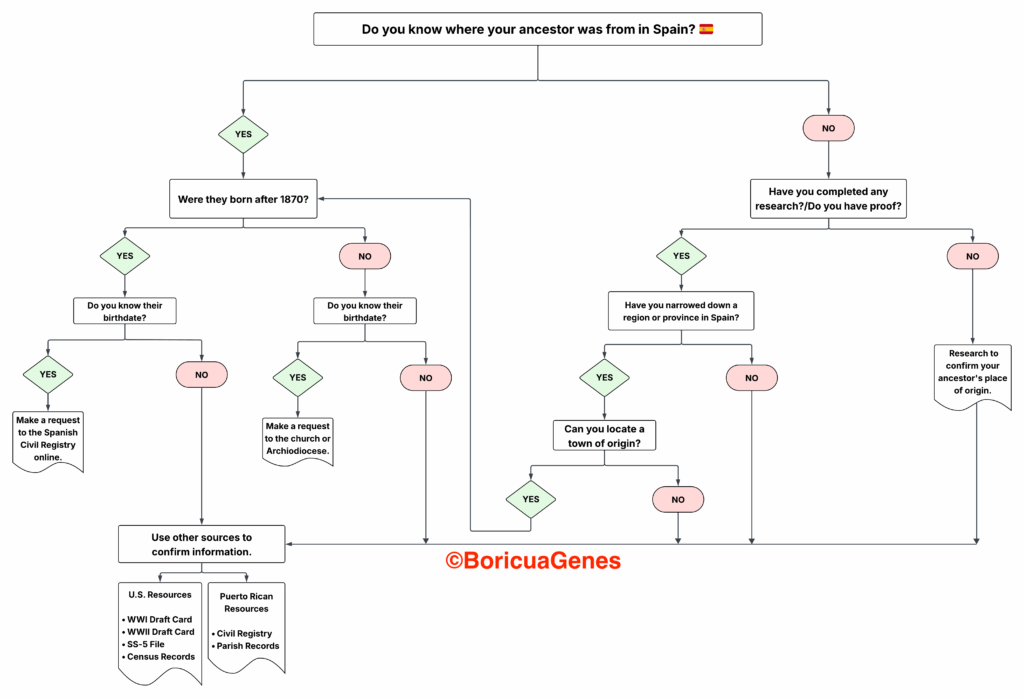
This answer can be quite a mixed bag! For some it is an easy journey to their Spanish ancestor if they are recent Spanish ancestry, say from the 20th-19th century; however, for those of us with older Spanish roots it can take some time. Below, is a chart on the different paths to take to locate your Spanish ancestor. Many (if not all?) Puerto Ricans have Spanish ancestry at some point in their ancestry. Getting started is the biggest step, but completing research can take quite some time depending on when your ancestor arrived to the island.
Post-1871 Spanish Research
If your ancestor was born after 1871, they should appear in the Spanish Civil Registry database. Typically, you can make this request online and for free; however, depending on the town or city it may require you to know the exact birthday of your ancestor, while some places will conduct a wider search to locate your ancestor. I have found that typically smaller towns will conduct a wider search since they do not have to go through many records; however, a big city might not have the time and resources to check over so many entries over a range of years.
This is why researching your ancestor first is important. Many people think locating a Spanish ancestor can be done via the click of a button. And while though a lot of places are becoming more modernized… there is still a look of legwork to be done with research. Which brings me to my next point.
Pre-1871 Spanish Research
This type of research is typically a bit harder since it requires religious research in parish books; therefore, it may require someone going in person to locate the record you need. This can take time as you locate where the records are, who can access them, when the archive is open, and other logistics. Definitely check out my post about how to hire a professional genealogist!
I have been fortunate enough to be able to research two of my own lines in Spain – my Magraner line from Sóller, Mallorca, Spain and my Dávila/Cantos line from San Juan del Puerto, Andalucia, Spain. Feel free to read these posts below to get an idea of two types of research.
Research in a larger archive
1. Research in Mallorca (Part I): A visit to the Arxiu Diocesà
2. Research in Mallorca (Part II): A visit to the Arxiu Del Regne
3. A Visit to the Obispado de Huelva
Research in a smaller church
Conclusions
Spanish research (and any other research for that matter) can be exciting, frustrating, rewarding, and everything in between. Sometimes we hit the jackpot early on in our research and other times it takes us searching page-by-page in badly maintained books to locate our ancestor. Nonetheless, the challenges and work to get here are completely worth it (in my opinion). It has lead me to moments like the one below – being able to stand in front of the home of my ancestor from Mallorca some 100 odd years later. To me… this makes genealogical research all worth it!

Excellent work! I always enjoy your posts!
Thank you so much for all of your hard work.I have been stuck for a while on my ancestry journey, but thanks to you I found new information in the news paper article. Thank you again.
So glad my blog has been helpful! Good luck with your research!
Hola, vi tu investigación en la familia Lamboy. Yo soy Iyana Lamboy y te queria comentar que los Lamboy hay en San Sebastian. Que debería buscar alli a ver si encuentras mas. Mi tatara abuelo es Rufinio Lamboy, quien tuvo 12 o 14 hijos 7 hembras y 7 machos. El origen del nombre es de Francia o Alemania. Por lo que tengo entendido los Lamboy de Puerto Rico muchos pueden ser Judios de Alemania que se acentaron en San Sebastian hace unos 200 a 500 años atras. Me encantaria mantenernos en comunicación para yo poder aprender mas sobre mi familia.