About five years ago, I learned that my Román Ayala branch originated in the town of Arecibo but made their way to Guaynabo. This was very interesting to me because the Román branch married the Rivera branch of Toa Alta and for some long I had no idea they were from a town outside of Toa Alta. In learning more about the origins of my Ayala branch, I learned something that sometimes is inevitable in New World genealogy – some of my de Ayala ancestors were slave owners. I had no idea about this, especially since we are taking about a family branch that lived in the eighteenth century.
Today I want to spend some time talking about Juan Fernández Ayala and Josefa de los Olivos – individuals who held people in bondage in eighteenth century Puerto Rico.
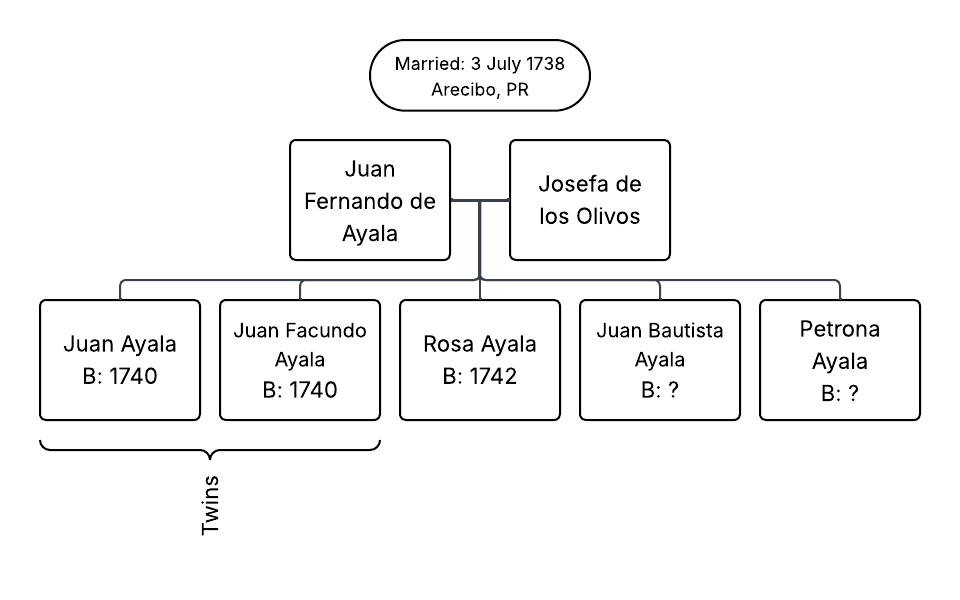
de Ayala de los Olivos Family
Above is a simple tree of my de Ayala de los Olivos branch. Juan Fernando (occasionally Fernández) de Ayala and Josefa de los Olivos were natives of San Juan; however, they married in 1738 in Arecibo and had at least five children. Three of which were confirmed to have been baptized in Arecibo. Interestingly, Juan Ayala (my 6th great-grandfather) was a twin.
Though living in Arecibo in the mid-1700s, by the 1780s they were closer to San Juan, when they moved to Guaynabo. We know this because various records of enslaved individuals appeared in Guaynabo tied to the names of my ancestors.
It should be noted that my ancestor, Juan Ayala, also went by Juan Fernando or Juan Fernández (de) Ayala as did his father.
Arecibo and Guaynabo
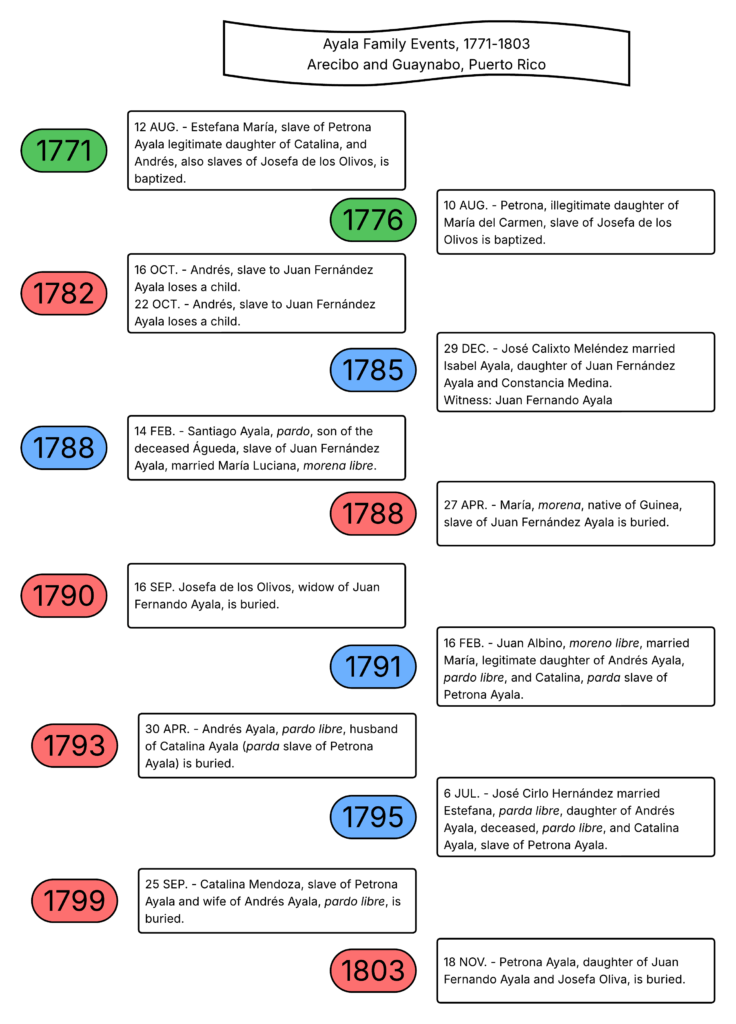
A chart below summarizes a few events of the de Ayala family in both Arecibo and Guaynabo. Since the Arecibo records are largely unavailable online, I have very limited information about my ancestors there. Hopefully in the future, records will become readily available and help to figure out more dates important to my family’s time there.
By analyzing these various events I can begin to see some trends. For example, Andrés and Catalina likely belonged to Josefa de Olivos in 1771, while their daughter Estefana belonged to Petrona Ayala. By 1782, Andrés belonged to Juan Fernández Ayala (likely Josefa’s son) and by 1791 Andrés is freed. It is possible that with Josefa’s death Andrés had been freed; however, we are not sure when either son or father named Juan Fernando/Fernández Ayala died. This was more likely when Andrés was freed seeing as he belonged last to him. Meanwhile, his wife Catalina (also appearing as Catarina) had been transferred to Petrona and she remained enslaved until her death in 1799. Interestingly, Catalina died with the surname Mendoza. Finally, Petrona died in 1803. Lastly, Estefana belonged to Petrona throughout most of her life, since her birth in 1771 to at least 1795 when Estefana married.
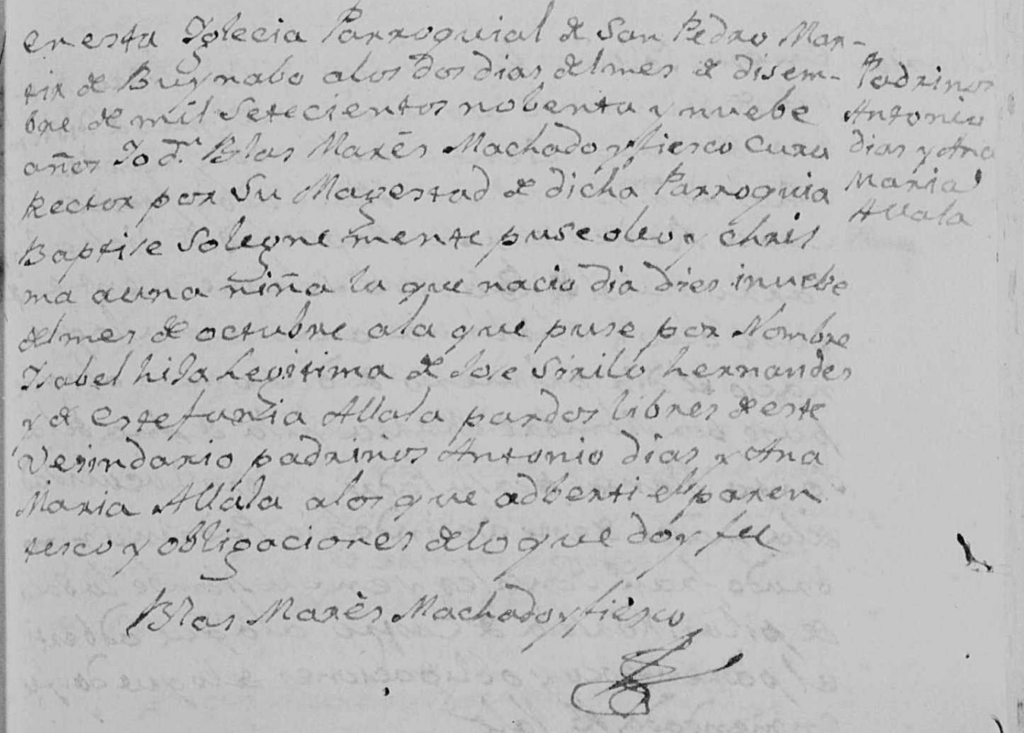
Estefana (registered as Estefania) later appeared in 1799 with her husband José Cirilo Hernández baptizing a daughter named Isabel. By this time Estefana/Estefania was freed seeing as how both of them were referred to as pardos libres. This means that Estefania was freed before Isabel’s baptism in 1799 and sometime after 1795.
Source: Iglesia Católica [Catholic Church] San Pedro Mártir (Guaynabo, Puerto Rico), “Bautismos [Baptisms], 1792-1803," p. 204, second entry, Isabel Hernández, baptism, 2 December 1799; accessed as “Puerto Rico, Catholic Church Records, 1645-2021,” browsable images, FamilySearch (https://www.familysearch.org/en/search/collection/1807092 : accessed 8 March 2026).
Unfortunately, none of the burial records found in Guaynabo such as Josefa de Olivos’s or Petrona Ayala’s mentions anything about leaving behind a last will and testament. So either the records in this time period or town simply did not mention whether this was done before their deaths or if they actually did not leave anything behind (which is hard to believe since they owned enslaved individuals).
If I visit the Archivo General again in the future it would be good to see if there were any notarial books for Guaynabo from this time period to double check if the Ayala family left behind any last wills and testaments. Similarly, checking for freedom records will be important as well.
Analyzing these records help to contextualize when my ancestor Juan Fernández Ayala likely died. The only issue is that occasionally I do not know when they refer to the son or the father since I also don’t have Josefa’s husband’s death record. I just know he died before her.
The more I continue to analyze these records, the narrower of a window I can create to search for death records. These records also help to better understand the life my ancestors had in eighteenth century Puerto Rico. Though note a proud moment of history in our family, it is one that I must deal with and come to terms with.
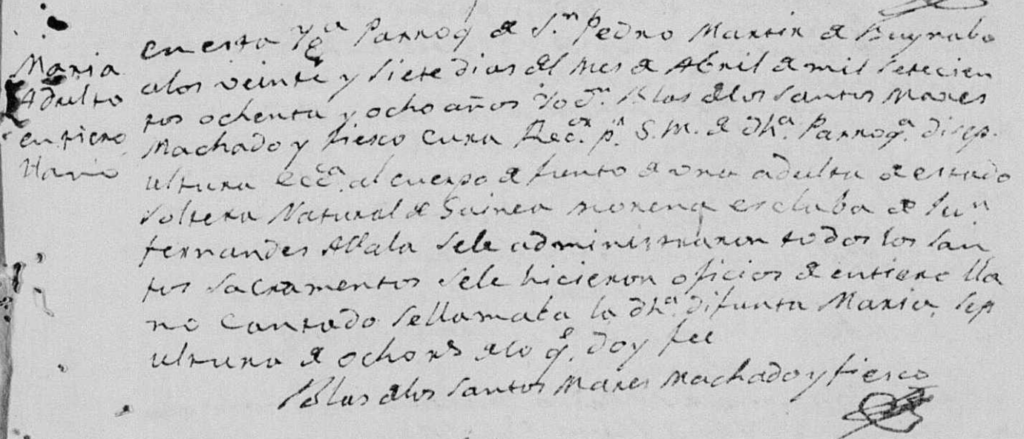
Cover image source: Iglesia Católica [Catholic Church] San Pedro Mártir (Guaynabo, Puerto Rico), “Defunciones, 1772-1811,” vol. 1, p. 103, no. fourth entry, María, burial, 27 April 1788; accessed as “Puerto Rico, Catholic Church Records, 1645-2021,” browsable images, FamilySearch (https://www.familysearch.org/en/search/collection/1807092 : accessed 8 March 2026).