
Earlier in the year, I had used LucidChart to chart out the female descendants of Eglantine Lautin – my 5th great-grandmother. This was done in hopes of identifying which female lines left no female descendants and which ones could provide me with a potential daughter, still alive today, who would be the carrier of Eglantine’s mtDNA haplogroup. Though I have not been able to find and contact any living female descendants, it allowed me to visually map out which branches to target and continue researching.
Since I wanted to study my Rivera line more in relation to my genealogical resolutions of 2025, I decided to create a similar chart for my Rivera branch since I have yet been able to find any other male descendant who overlaps with me on the paternal haplogroup.
de Rivera/Rivera Male Descendants
Feel free to read more about my direct paternal line, Rivera, and the paternal haplogroup associated to it. “An update to Y-DNA: A look at the Rivera line“
My oldest direct male ancestor was named Pedro de Rivera and likely born in the mid-1700s in Toa Alta, Puerto Rico. Given the lack of records from this time period, it is uncertain when he was born, when he married his wife María Morales, and when he died. We know that he likely died after 1802 and that likely he would have married in the 1760s-1770s; however, all of these dates are estimates. Having no direct records for an ancestor can sometimes make looking for them feel like taking a shot in the dark seeing as how you do not know much about their life. Was this Pedro’s first, second, or third marriage? Did Pedro move to Toa Alta from a nearby town?
Therefore, I am left with many questions regarding Pedro de Rivera’s life and the origins of my surname. So far, the Rivera line has been in Toa Alta since the 1700s, but where did it originate before that? The de Rivera family is usually referred to as pardos (mixed race individuals) which likely means that they had undergone generations of intermixing on the island between Spaniards, natives, and potentially African ancestors.
My goal is to one day discover the origins of the de Rivera line (as it likely originated in Europe based on my Y-DNA results) and similarly I would like to find other de Rivera descendants who come from Pedro de Rivera. I have always found it weird that despite having a fairly common surname in Puerto Rico, it seems that my specific branch either did not produce that many male children down to the modern-day or that I am not a “true” de Rivera – that somewhere earlier in my branch there was a NPE (non-paternity event) that caused me to not receive paternal matches with other Rivera-surnamed men.
Therefore, I wanted to map out the male descendants of my surname and see where I could turn to to locate more male cousins that could potentially test and who could exchange notes with me on the origins of our surname. Below is the map showing the product of that work!
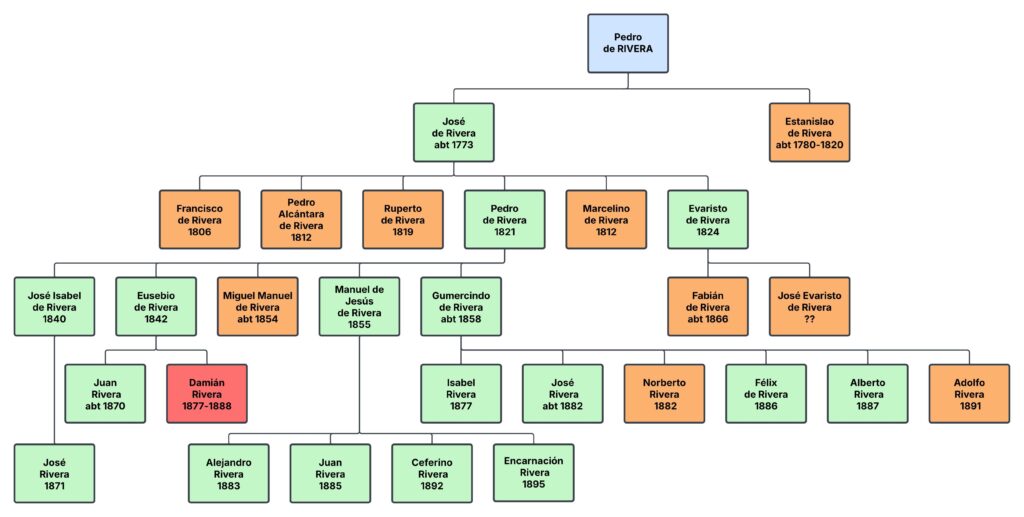
As you can see – I have a lot of orange boxes! This means that there is a potential there for male descendants; however, I have not researched those branches to say definitively whether or not there are men who exist in modern-day and that share their surname with me.
Next Steps
My next step in order to flesh out this tree is to use the civil registry of Puerto Rico and the parish records of Toa Alta to continue researching these male cousins, uncles, etc. to better understand what happened to their lines. Only on one line can I say that I do not have any potential male descendant testers and that is through Damián Rivera, the son of Eusebio de Rivera, who died when he was 11 years old.
Everyone else seems to be fair game! Finding out if they married, died young, and whether they left descendants will help me to continue updating this tree to learn more about my line. Similarly, being able to test other members of the de Rivera branch who do not descend from Manuel de Jesús Rivera like me can help me to see if they also received the same Y-DNA haplogroup as me. If my haplogroup is different from say the male descendants of José Isabel, Eusebio, and Gumercindo Rivera it will mean that my line originated from another man and not with Pedro de Rivera.
Unfortunately, Pedro de Rivera (grandson to the patriarch) seems to be the only male Rivera child who left children. Research will be the only way to confirm who else exists out there descendant from these men.
I highly recommend creating charts like this if you are stuck with your ancestral research and want to locate other people who share the same Y-DNA (or mtDNA) haplogroup as you. It can also help you to identify weaker areas in your tree that can use some more research in order to strengthen your understanding of that family.
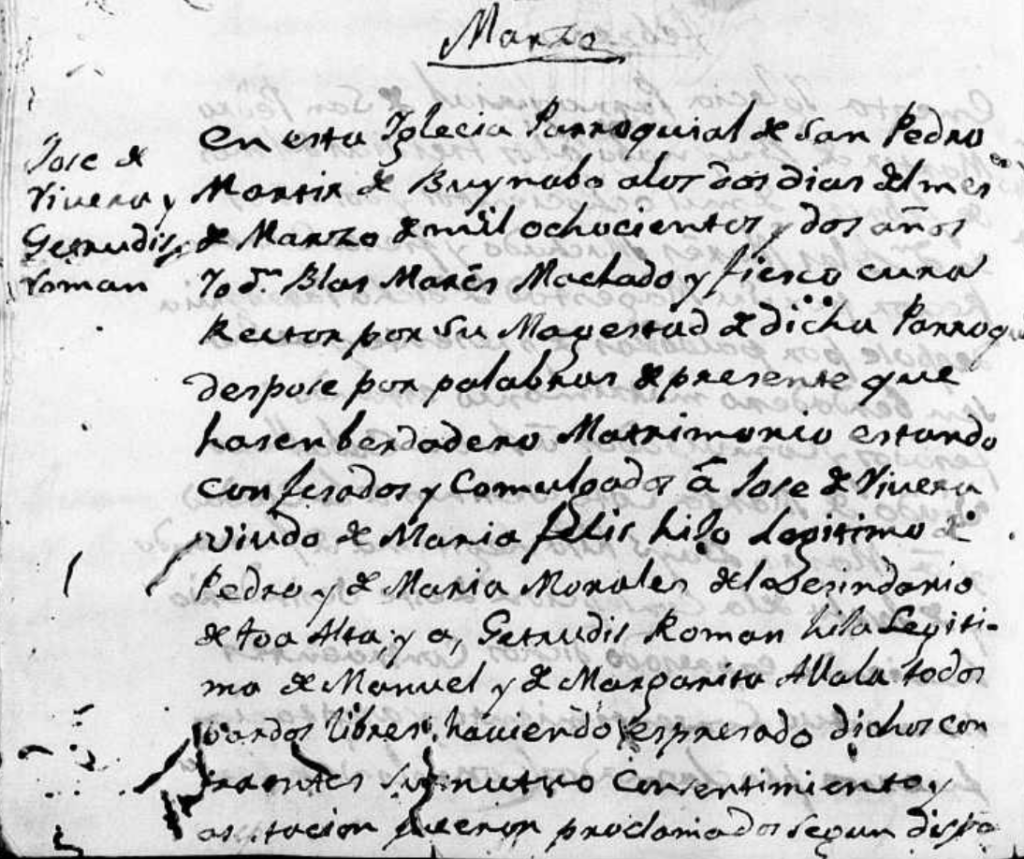
Cover Photo Source: Iglesia Católica San Pedro Martír (Guaynabo, Puerto Rico), “Marriages Nov. 1790- Oct. 1858,” pg. 199vt, last entry, Jose de Rivera & Gertrudis Román, marriage, 2 March 1802; accessed as “Registros Parroquiales, 1854-1942,” browsable images, FamilySearch, (https://www.familysearch.org/search/collection/1807092 : accessed 7 December 2025).
I have been trying to find a Micaela de Rivera that had a few children with Jose Vicente Echevarria in San Juan. It was in the early 1800. Would you happen to have any data? BTW, very good article. Will study it and see if it provide insights into a few brick walls that i have in my family tree.
Hi, Luis! Thanks for reading. I do have a Micaela Rivera; however, she was married to Juan José Laureano Pérez and they lived in Corozal. I would say definitely check out neighboring towns. I found my Toa Alta ancestors marrying in Guaynabo – you never know!