

Sometimes in our genealogical research, we come across an individual who had the same name as our ancestor and we have to decide – is this the same person or someone else? We therefore have to ask ourselves: How can we use records to help us deduce whether there is an overlap in identity or if we need to create a completely new individual’s timeline to diverge their life from our own ancestor.
In this post, we will look at the identify of a man (rather, two men) named José de León and how studying his (their) life allowed me to identify which was my 5th great-grandfather.
Background
I know that my 5th great-grandfather was named José de León and that he lived in Coamo, Puerto Rico. During the earlier appearances of José in genealogical documents, he only appeared with the name “José de León”. It was not until 1814 that he used the surname Correa in the baptism of his son Antonio Abad. Therefore, when I searched for José de León I found another man with the same name in Coamo living there at the same time as my great-grandfather. The question of course was: Was this actually a different man or could this also have also been my ancestor?
Below are some ways I was able to learn whether or not these two men were the same individual or two completely different men.
1. Marriage
A fairly easy way to separate out identities is to see when the individuals married and if their information overlapped. Was one of them widowed and later remarried therefore showing a merge between identities? Or did both men marry at different times? In different places? To different women? Tracing a marriage can help to determine the likelihood of merging identities.
My José
Other José
My ancestor married Rosa Ortiz on 29 May 1809 in Coamo, Puerto Rico. At the time of this marriage he was listed as single and a native of San Juan; therefore, this would have been his first marriage. He later married on 21 November 1819 in Coamo to María de la Cruz Rodríguez Ruiz (my 5th great-grandmother). José’s earliest children include:
1. Ramona, legitimate daughter of José de León and Rosa Ortiz, pardos (1810)
2. Juana, legitimate daughter of José de León and Rosa Ortiz, pardos (1811)
3. Antonio Abad, legitimate son of Josef de León Correa and Rosa Ortiz, pardos (1814)
José’s parents were also listed on his marriage record as Francisco and Eugenia Carcaño. Unfortunately, I have not been able to find more information about them in either San Juan or Coamo. They are a great mystery and brick wall in my research!
This José de León likely married before 1765 to Estefanía Colón; however, no marriage record was found for this couple in Coamo in this timeframe. It is important to note that earlier records are missing from Coamo. Similarly, it is also possible that José de León came from another town and married Estefanía there. Though there is no marriage, a few birth records were found in Coamo showing how early this couple started having children.
1. Tiburcio, legitimate son of Joseph de León and Estephana Colón (1765)
2. Manuel, legitimate son of Jph [Joseph] de León y Estepha [Estephana] Colón, of this valley (1767)
3. Ignacio, legitimate son of Jph [Joseph] de León and Estefana Colón, of this valley.
This helps to date the couple’s marriage to before 1765 and likely in/around Coamo.
2. Race
The use of race can also be a helpful determinant for identifying whether an individual’s identity. This can be hard in Puerto Rico as sometimes race changed across documents and years, but it can be a helpful beginning point if the evidence is clear, solid, and unwavering across the documentation.
My José
Other José
My ancestor almost always was identified as a pardo – this term related to mixed race peoples in Puerto Rico. There is no clear definition, but it likely involved the mixing of Taíno, African, and Spanish blood.
This José de León does not clearly appear as a specific race in his documents. I have in my notes that this José was classified as blanco (white), but at the time I did not jot down where this appeared (…bad genealogist!) and so now I cannot remember which document I saw it in.
3. Census
The U.S. census records created in 1910 and onward in Puerto Rico can be super helpful when it comes to identifying where a person lived and other details about their life such as their profession, their spouse and children, and sometimes other details such as their education level and whether they owned land.
However, before 1910, there are not many census records available for the island. I was lucky to find a census record for Coamo from 1824. Using this resource was important for separating out these two men.
My José
Other José
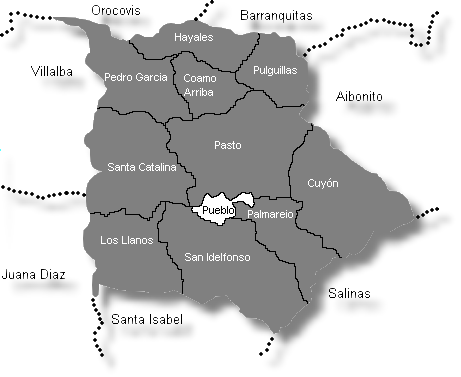
In 1824, my ancestor appeared living in the barrio (neighborhood) of Santa Catalina, Coamo, Puerto Rico.
The other José de León appeared living in the barrio of Llanos, Coamo, Puerto Rico.
4. Death
This is probably one of the clearest documents that can be helpful for separating out an identity (besides a birth/baptism or marriage record which we don’t have in this case… just a marriage for my José de León). Finding two separate death records can help to show that the individuals were two separate individuals as typically death records are only created once for a given individual.
My José
Other José
My ancestor died on 21 December 1856 in Coamo, Puerto Rico. His death record listed him as José León Correa, 64 years old, the legitimate husband of María de la Cruz Rodríguez (second marriage). This means that José de León Correa was born about 1792. He did not leave a last will and testament.
Though José’s parents’ names were not included, I am sure this is my ancestor given when he died and the name of his wife, my 5th great-grandmother. Similarly, the death record does not list where in Coamo he died.
This José de León died on 19 June 1832, also in Coamo, Puerto Rico. His death record stated that he was 92 years old (born about 1740), married first to Estefanía Colón with whom he had the following children: Tiburcio, Manuel, Ignacio, Fermín, Ignacio de la Candelaria, Bacilio, María Catalina, Antonia, Benita, and María del Rosario.
He was married a second time to Juana Collazo with whom he had Bernardina, Domingo, María de la Cruz, María José, Hipólita, María Eugenia, and Feliciana.
José left a last will and testament “extrajudicial” where he named his wife Juana Collazo as his heir, then Ramón Torres, and lastly his son (name not mentioned). Extrajudicial means that José did not appear before a notary and therefore his will is likely not officially recorded anywhere since it was done “outside of the law”.
5. Other Resources
Depending on when you are searching for an individual you maybe able to find other resources such as newspaper articles, passenger manifests, and in Puerto Rico you can usually study the grandchildren of the individual as usually they will be listed and sometimes some important information can be found even in the documents of a grandchild.
Since I am dealing with ancestors that were alive before the time Puerto Rico became a U.S. territory, it is important to use as many documents as possible to study their identity.
Conclusion
Based on the evidence I have found, I can deduce that these two individuals were likely different men. Though my ancestor went by “José de León” in earlier records, he later added Correa to his name; however, we still do not know why he did this. The other José de León never added another name.
Similarly, we know that my ancestor’s parents were listed as Francisco Correa and Eugenia Carcaño based on his first marriage to Rosa Ortiz. Since we have been unable to find a marriage for José de León and Estefanía Colón, it is not clear who his parents were. Similarly, his death record did not provide this information. One thing is clear based on the death records is the age gap between both individuals – my ancestor was born about 1792, while the other José de León was born about 1740.
Despite gaps in information, having their death records, their appearance in the 1824 Coamo census, and the proof of their separate marriages help to create two different profiles for these men.
This is why compiling as much information about an ancestor is important because you never know when someone will come along with a similar name!