Following the post on how to trace your Spanish ancestors, I wanted to spend some time talking about tracing your indigenous ancestry. The main takeaway is that this research is hard! Since Puerto Rico became fairly mixed, fairly quickly, it is quite difficult to find your ancestors on paper listed as Taíno. With that in mind, we can take a look at different ways to identify and trace your indigenous ancestry in Puerto Rico.
Who were the native people of Puerto Rico?
The Taíno are known to be some of the earliest peoples to arrive to the island of Puerto Rico. Archaeological and other studies are showing that the Taíno were likely not just a single group of people to arrive in the Antilles. More likely, various ways of cultures arrived from the north of South America (from areas near Colombia and Venezuela) and inhabited islands such as the Dominican Republic, Cuba, and Puerto Rico. Modern studies are working on learning more about the Taíno through their descendants and through local tribes still around today in parts of South America with genetic connections to the Taíno. The hope is that by studying their DNA, cultures, languages, and other aspects of life, we will be able to learn more about the people that called Borikén/Boriquén home.
DNA Evidence
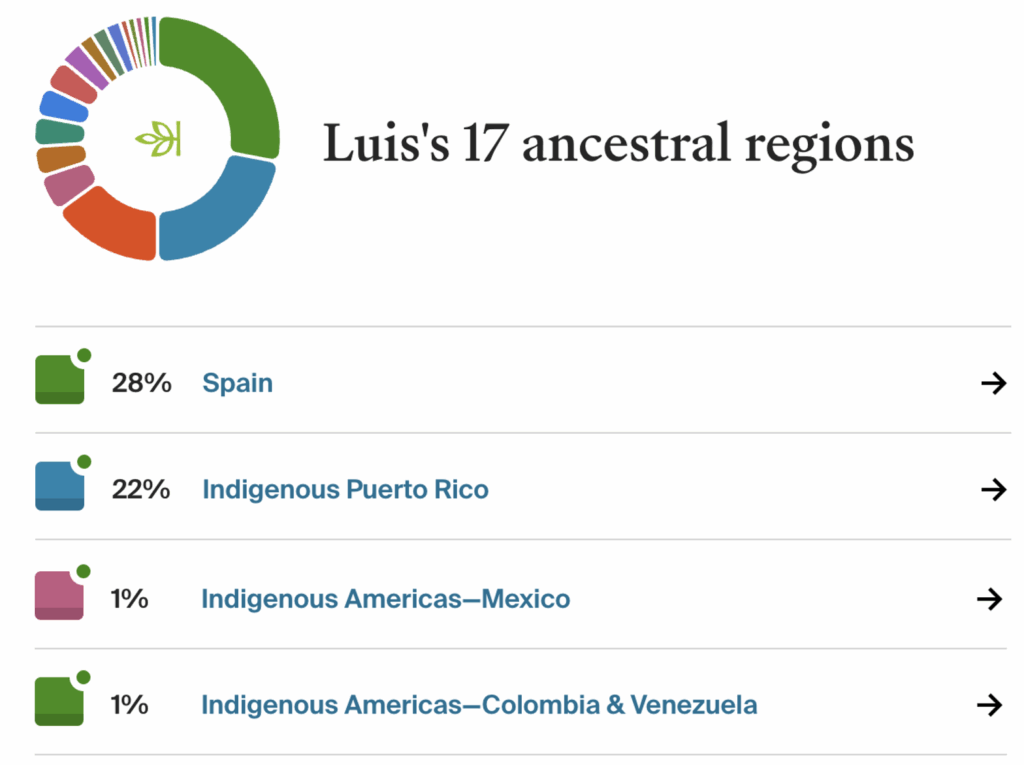
One of the most important ways of knowing if you have indigenous ancestry is DNA evidence. It is important to keep in mind that many DNA tests provide estimates of your percentages inherited from your ancestors. This means that numbers will fluctuate as the science becomes more accurate and/so more samples are added. If you have tested with 23andMe and AncestryDNA, you will notice that the numbers are usually not the same (though they can be close). For example, on AncestryDNA I have 22% Indigenous Puerto Rico DNA as well as 2% Indigenous DNA from México and Colombia & Venezuela. It is very possible that these smaller 1% chunks are being misread and should be lumped in with my Indigenous Puerto Rico DNA, but again, for now this is what my DNA is showing.
Source: “Origins”, Ancestry (https://www.ancestry.com/ : accessed 9 August 2025). Username and password of Luis Rivera privately held by the author.
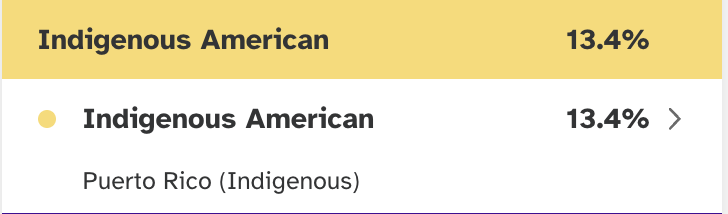
My 23andMe on the other hands shows that I have 13.4% DNA from Indigenous America – specifically from Puerto Rico. This number has always been fairly steady since I took my 23andMe DNA test back in 2010. The number has fluctuated a bit, of course, however I trust this number much more since having 25% Indigenous DNA feels like a lot, especially since I have not had new Taíno DNA brought into my family likely since at least the 1500-1600s. That is to say that I do not have a full-blooded Taíno ancestor who entered my family in recent years as would a Spanish or African ancestor.
Source: “Ancestry Composition”, 23andme (https://www.23andme.com/ : accessed 9 August 2025). Username and password of Luis Rivera privately held by the author.
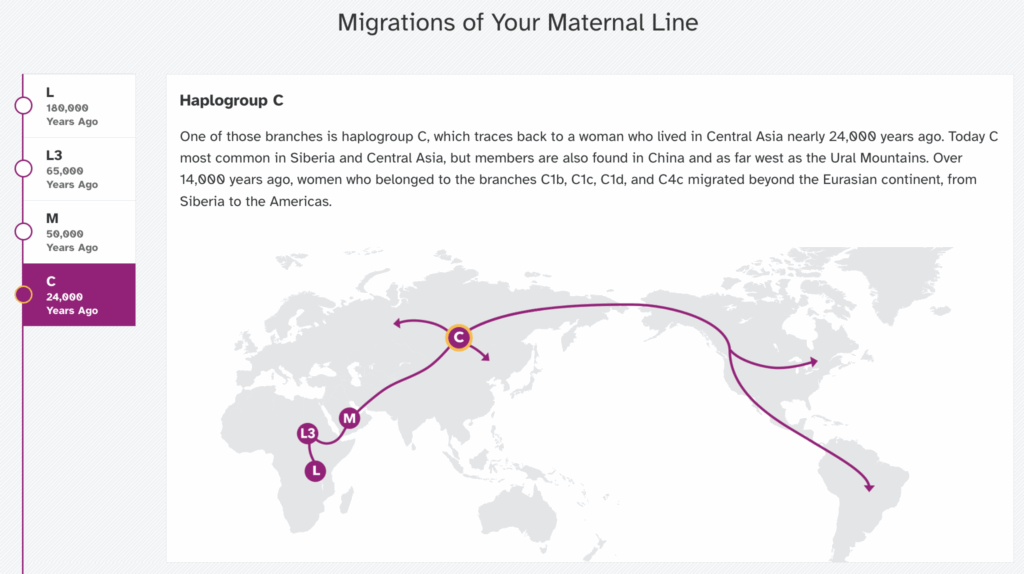
A last piece of evidence can be your haplogroups, which for Puerto Ricans are usually their maternal haplogroups. These can provide you some insight as to whether your direct line may have been an indigenous ancestress. This the case for me as my maternal haplogroup, C1b4, is tied to an indigenous woman who lived less than 15,000 years ago. On paper, my ancestry on my direct maternal line goes back to Bárbara Vásquez who was born in the early eighteenth century likely in Humacao, Puerto Rico.
Source: “Maternal Haplogroup”, 23andme (https://www.23andme.com/ : accessed 9 August 2025). Username and password of Luis Rivera privately held by the author.
Source: “Maternal Haplogroup”, 23andme (https://www.23andme.com/ : accessed 9 August 2025). Username and password of Luis Rivera privately held by the author.
Document Evidence
So far, in my 21 years of research, this has been the hardest element of confirming indigenous ancestry. This is because in most Puerto Rican records, you will not see any designation or mentioning of Taíno ancestry. The closest classification is likely the term pardo which appears on records as early back as the seventeenth century in my tree and potentially earlier. You can read a few posts on my blog regarding my pardo ancestors.
I cannot definitively tell you which of my lines has indigenous ancestry or which of my ancestors was “pure-blooded” Taíno, but with documentary evidence I can begin to parse out which lines are likely to be the mixed lines in my family that carry Taíno DNA (hint: a lot!). Besides my branches from Mallorca, southern Spain, Martinique, and Guadeloupe, a lot of my ancestors are bound to carry percentages of Indigenous DNA that ultimately trickled down to me.
By continuing my research I can better understand the origins of my ancestors, which have been in Puerto Rico for a long time, and which were likely to be pardo and likely contribute to my 13.4% Puerto Rican Indigenous DNA. I can say though, without a doubt, that I maternally descend from an indigenous woman given my haplogroup. I also know that three out of four of my great-grandmothers carried indigenous maternal haplogroups as well, these being: C1, A2, and C1b4. The fourth group was L2a1, an African haplogroup.
Conclusions
As DNA studies get better and the more I can compare my DNA to other cousins and potentially older samples found in the Caribbean, the better I can get at pinpointing my native origins. It definitely is also frustrating to know that on paper I cannot name my Taíno ancestors because of colonization and the erasure of their lives both in genealogy and in real life. A lot of work is being done to recognize our native ancestors in Puerto Rico and the surrounding islands to revive their memories through song, dance, healing, language, food, religion, and other forms of memory still intact from our ancestors.
I am very excited for the day that I can say with certainty “I have found my first Taíno ancestor”!
Cover Image Source: “Taíno Women Preparing Cassava Bread”, La Historia del Mondo Nuovo 1565, Girolamo Benzoni – Wikimedia Commons (https://commons.wikimedia.org/wiki/File:Ta%C3%ADno_women_preparing_cassava_bread.png : accessed 8 January 2023).
1 thought on “A Puerto Rican Look At: Researching Your Indigenous Ancestors (Part II) ”



Luis: excellent article, very informative.
Maritere