
This morning I came across this YouTube video by Family Locket on using AI to map land using deeds. I was intrigued because I heard that recently ChatGPT had updated its model for creating images. Nicole (the presenter) was impressed by the accuracy of the image created and so I wanted to see what it could do for the one description I had of my ancestor’s home in Guadeloupe.
Here’s the video below if you’re interested in seeing how they went about creating the image.
AI can be used in many different ways in genealogy, probably the most common way is to use it for translations, transcriptions, and abstracting records found online. It can be a powerful tool for your genealogical research.
However, one of the most important things is to keep in mind that AI can be full of confirmation bias. At times in the past when I have asked it a question regarding Puerto Rican genealogy, it has quoted my own blog to me as a source and presented it as fact. Therefore, it is always important to verify the information gathered AI tooks such as ChatGPT, Gemini, Claude, etc.
Context
I had posted about my ancestor Gustave Jean-Charles and the house he owned in Guadeloupe before.
It was this description that I fed to ChatGPT to see what image it could render. The description was the original French from the notarial record found in the Archives Départementales de Guadeloupe. Here is the text in French and English.
“…un terrain situé en cette ville Basse-Terre, rue du sable numéro 32 parte au cadastre sous le #30, ancien numéro 32 canton et arrondissement de la Basse-Terre ayant 8 mètres extérieur de façade, sur la rue du sable et 19 mètres de profondeur, borné à l’est par la maison et le terrain de M. Rafaël Guilliod, aux droits des héritiers Vatable, le mur de séparation, étant mitoyen… au sud par la propriété des ayants droits du sieur Lavau, le mur de séparation, étant mitoyen… à l’ouest par le terrain et la maison de M. Paul Clayssen, aux droits des héritiers Vatable, le mur de séparation qui va de la rue du sable, jusqu’à un appentis ci-après désigné mitoyen… et au nord par la rue du sable.”
“…une maison construite sur le dit terrain ayant un rez-de-chaussée, un étage et un galetas, le mur du côté de l’est est en maçonnerie, une partie du mur du côté de l’ouest est aussi maçonnerie, tout le reste de la maison est en bois, la couverture est en aissantes, le rez-de-chaussée est composé d’une grande salle, d’un couloir, d’une galerie et d’un petit cabinet placé sous l’escalier qui conduit ‘a l’étage, le tout est planchéié. L’étage est composé d’une galerie et de trois chambres à la suite et au sud de la dite maison, se trouve une cour dans laquelle il y a deux appentis en bois couverts en aissantes, l’un à l’est ayant deux pièces et l’autre à l’ouest ayant trois pièces y compris la cuisine dans la même cour il y a un bassin et la fontaine…”
“…a plot of land located in this city Basse-Terre, rue du sable number 32 part of the cadastre under number 30, formerly number 32 canton and borough of Basse-Terre having 8 meters of exterior facade, on rue du sable and 19 meters deep, bound to the east by the house and land of Mr. Rafaël Guilliod, with the rights of valid heirs, the separation wall, being adjoining… to the south by the property of the beneficiaries of Mr. Lavau , the dividing wall, being adjoining… to the west by the land and the house of Mr. Paul Clayssen, with valid heir rights, the dividing wall which runs from the rue du sable, to a lean-to hereinafter referred to as adjoining… and to the north by rue du sable.”
“…a house built on the said land having a ground floor, a [first] floor and an attic, the wall on the east side is of masonry, part of the wall on the west side is also of masonry, all the rest of the house is in wood, the roof is made of slats, the ground floor is made up of a large room, a corridor, a gallery and a small cabinet placed under the staircase which leads to upstairs, everything is planked. The [first] floor is composed of a gallery and three bedrooms following and to the south of the said house, there is a courtyard in which there are two covered wooden lean-tos, one to the east having two rooms and the other to the west having three rooms including the kitchen in the same courtyard there is a basin and the fountain…
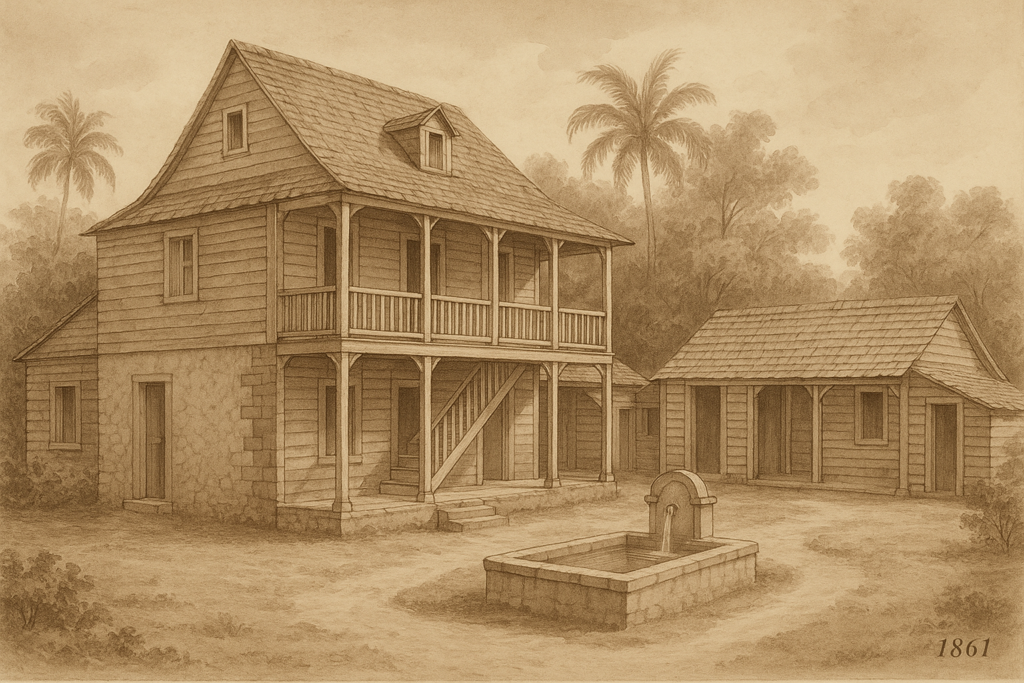
1st Rendition (September 2025)
This first image was created just last year with the above French description. I was already impressed by this image as it gave me a rough idea of what the house would have looked like. Having never seen it person, I figured this would be the closest I would get without having to go to Guadeloupe. And since there also exists the possibility that the house does not exist anymore as it did in the 19th century, that this image could give me a glimpse into something that is gone.
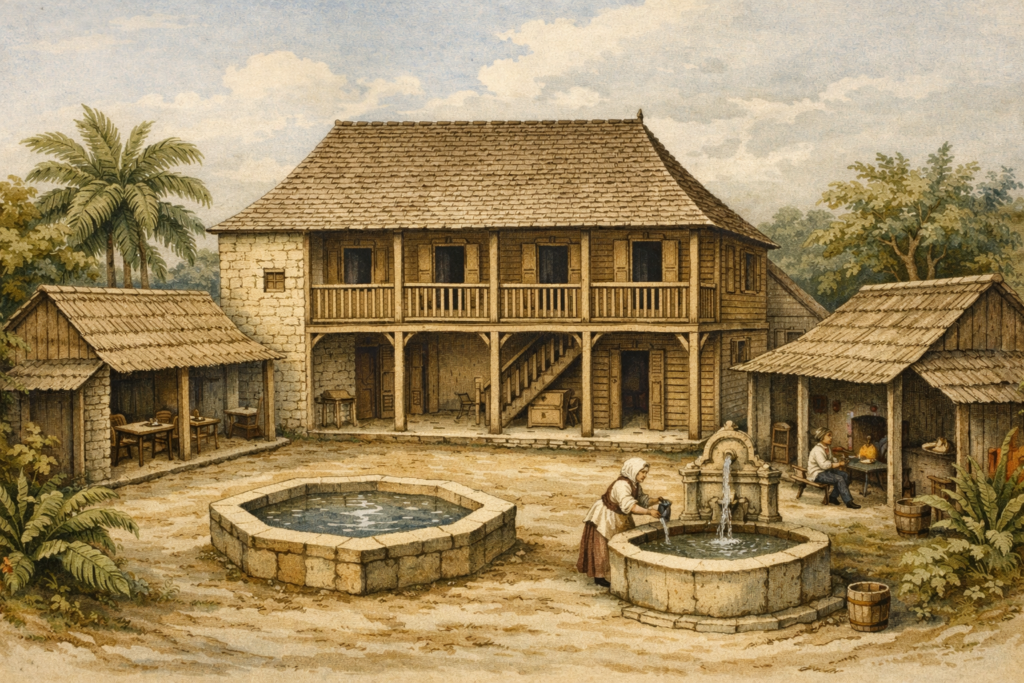
2nd Rendition (January 2026)
This second image was created four months after the first image and just four months ago. As you can see, it’s fairly similar to the first image, though there are of course some slight differences. For example, this image includes two fountains versus one. You could argue that could be slightly more correct as the description did mention a basin and a fountain (the first image includes them as a two-in-one design). Again, I thought this image was amazing as it gave me a better context as to how the house looked and including the people in the image gave it some more life.
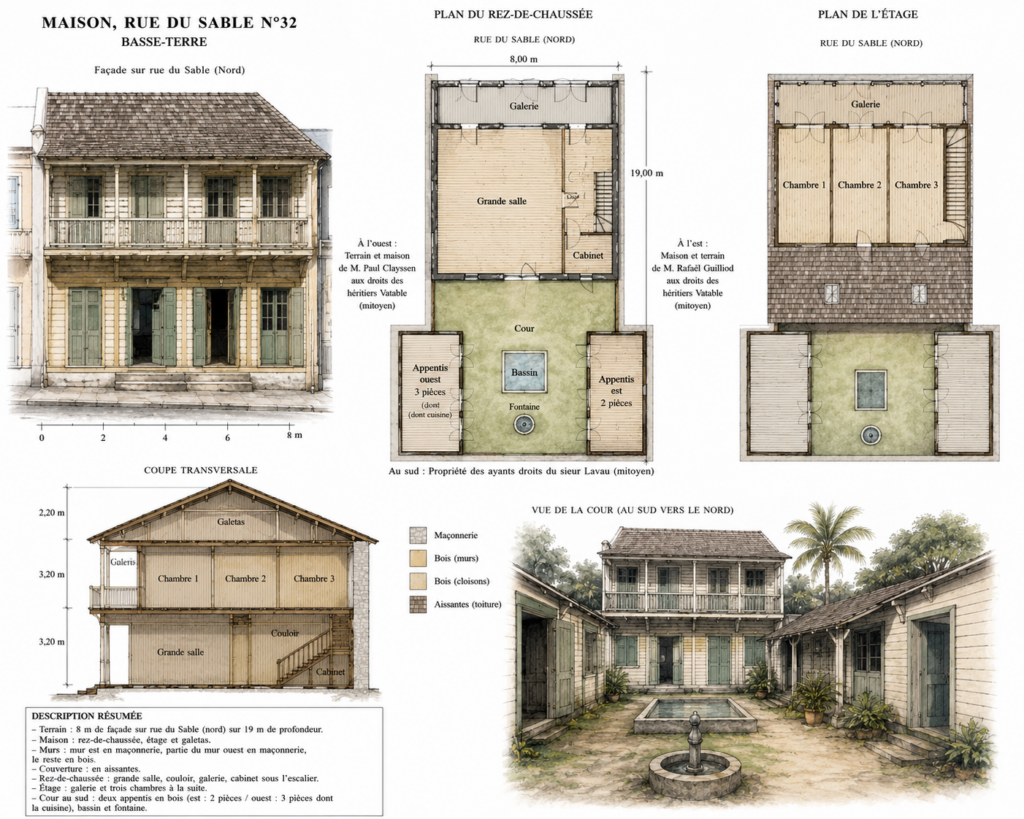
3rd Rendition (May 2026)
This last image was created today (May 8, 2026) and I was very impressed by it. It took the description and created an architectural breakdown of the house from different angles. It included the descriptions from the notarial record as well which was really cool to see. I loved that it also included a summary of the house on the bottom left as well.
I did prompt ChatGPT with some “meta-prompting” which is what Nicole refers to as getting the AI ready for the actual prompt by asking it some prior questions. For example, I asked ChatGPT:
“What would a genealogist and expert architect need to draw a home based on its description in notarial records?”
This led ChatGPT to layout what sort of information it would need to create this image. I then fed it the description and it was able to create this stunning rendition of the home.
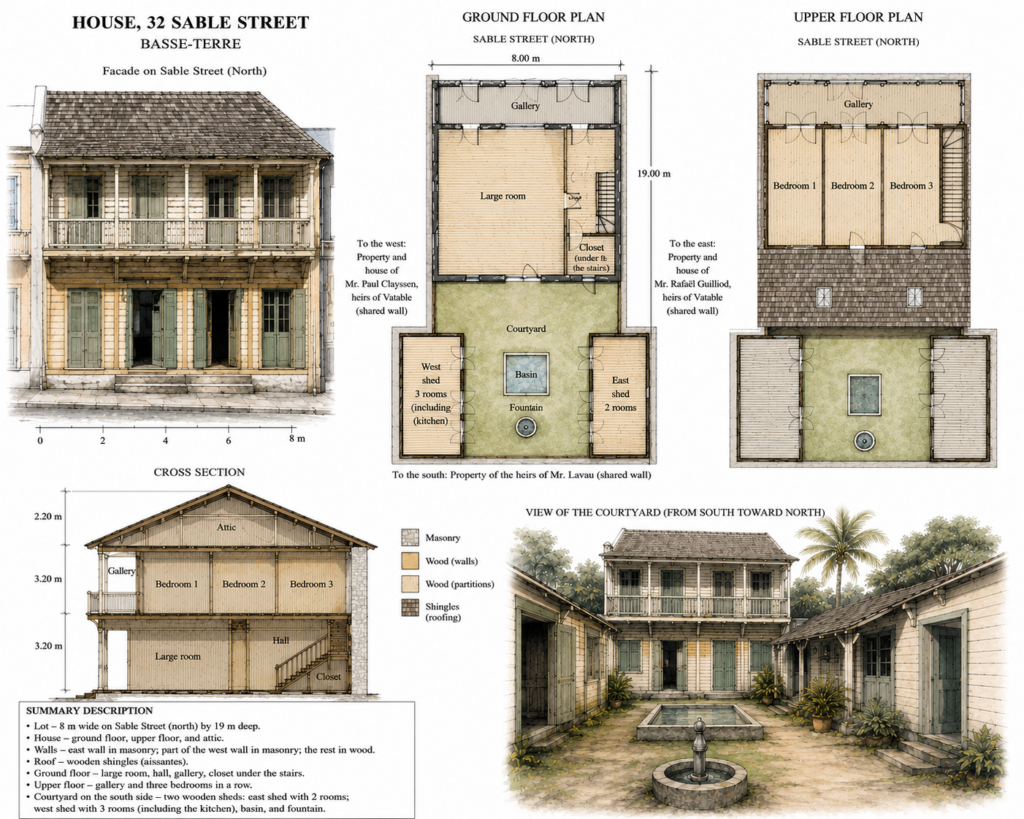
I also asked it to create the same image, except with an English description which it was also able to do.
Lastly, I asked it to place the home on a street in Basse-Terre, Guadeloupe, and to include people of mixed and African heritage on the street to reflect the population of the island. It also did a great job of that as well.
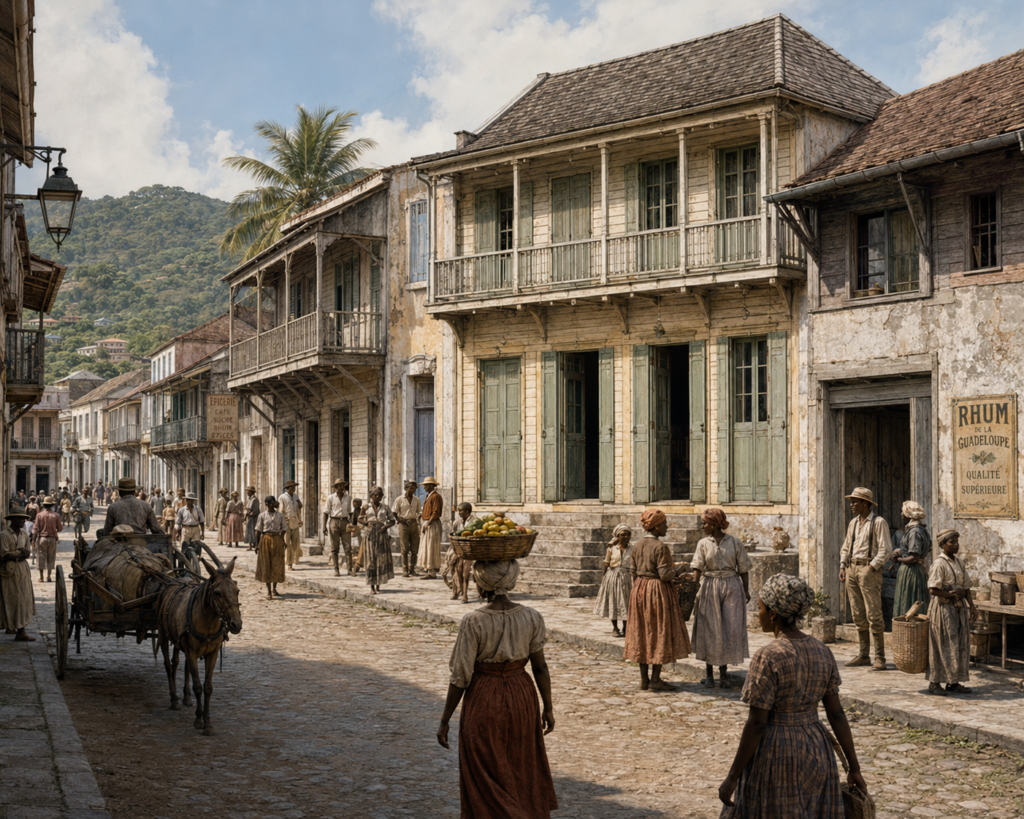
AI & Artistic Controversy
I think it is important to mention that not everyone is happy with what AI is doing when it comes to generating these images. And I will say I understand that it does take away work from artists and others. However, I also understand the ability to be able to use this tool to get an idea of something without having to do much heavy lifting.
Is AI perfect? No. Is this rendition the exact way it would have looked like in nineteenth century Guadeloupe? Hard to say. But it gave me a window into my ancestor’s life that I was only able to read in words prior to these images.
Each genealogist and person will have to decide for themselves if they’re willing to use AI and to what extend. I still try to limit my use of AI; however, this was something I was very curious about and wanted to see what it could do.
Unfortunately, I do not have many of these descriptions of land and houses of my ancestors. I was lucky to have found this description in notarial records from Guadeloupe. I do have one notarial record from Puerto Rico that describes my ancestor’s land in Lares; however, it lacks a lot of the finer details this record from Guadeloupe offered.
I am interested in seeing how AI will continue to evolve to allow images such as these to get better and better.