One of my goals this year is to learn more about Puerto Rican history and to create a timeline to help me better understand events that occurred throughout the lifetime of my ancestors. I have not really thought about how I want to go about this – whether creating just one big timeline or different mini ones addressing social, political, and other events.
However, I wanted to point out a source that maybe others have not come across, know about, or know where/how to find them. These are books known as Notas para su historia.
Importance of Historical Resources
With working on my timeline idea and other genealogical projects I have going on in the moment, I wanted to immerse myself more into Puerto Rican history. One of the most important things to understand while doing research is how and when each municipality was created.
Many times I will get questions about why a person can’t find their ancestors in X town.
Question: I don’t find my ancestors in Salinas in the 19th century, where have they gone? Answer: Have you checked in the town of Coamo?
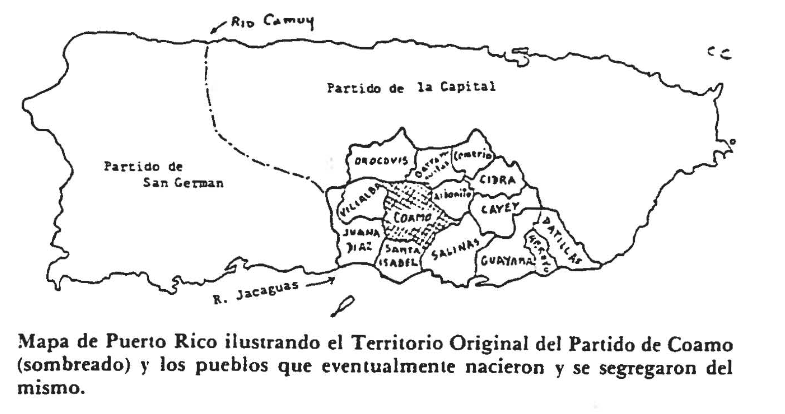
This simple interaction outlines the importance of knowing when, for example, Salinas was founded. Without that knowledge, you would not know that Salinas was originally a part of Coamo (which was a much bigger town, map to follow). My Correa ancestors lived in Salinas and then “migrated” from Coamo before that. I placed migrate in quotation marks because it is much more likely that my ancestors had been present in Salinas via Coamo much earlier than the towns founding and where just there when it finally established itself as its own municipality.
Understanding these dates, the geographical boundaries of municipalities of the island, and other important historical events can help to make you a better genealogist.
"Notas para su historia"
This is where these books known as Notas para su historia come into play. I recently found a resource through the Rutgers Puerto Rican Archival Collection (which I had no idea even existed) and provides a copy with OCR technology for various towns. Technology is not perfect, but something is something! It’s still worth searching/reading each page to find the information you are looking for.
Not every town, from my understanding, has one of these books. However, the Rutgers collection has a wide variety of towns.
By looking at the book regarding Coamo I was able to learn more about its origins and much more. The book includes information about what was harvested in Coamo, the names of landowners, slave owners, the geography/borders of the town, and other important information compiled by historians.
Source: Ramón Rivera Bermudez, Coamo: Notas para su historia (San Juan, Puerto Rico: Oficina Estatal de Preservación Histórica, 1983), p. 19, re: Coamo map; “Notas para su Historia-Municipios de Puerto Rico–1980s,” The Rutgers Puerto Rico Archival Collaboration (PRAC) (https://prac.rutgers.edu/historias-de-los-pueblos-1980s/: accessed 28 March 2026).
For example, the above map shows the various towns that came from Coamo – amongst them is Salinas to the south. You can see that about 12 other towns are also included in what used to be the territory of Coamo.
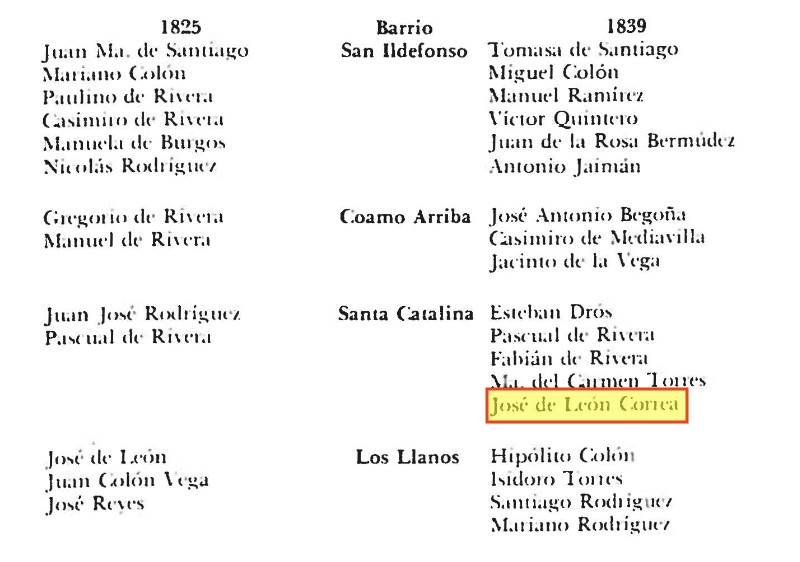
Source: Ramón Rivera Bermudez, Coamo: Notas para su historia (San Juan, Puerto Rico: Oficina Estatal de Preservación Histórica, 1983), p. 71, re: José de León Correa, “Notas para su Historia-Municipios de Puerto Rico–1980s,” The Rutgers Puerto Rico Archival Collaboration (PRAC) (https://prac.rutgers.edu/historias-de-los-pueblos-1980s/: accessed 28 March 2026).
Similarly, searching the book I was able to find a mention of my ancestor José de León Correa residing in the barrio (neighborhood) Santa Catalina. José de León has been a very elusive ancestor for me so finding his name anywhere is amazing!
Finding him listed here in 1839 is in line with a previous census where I found him listed in the same neighborhood in 1824. Placing him in Santa Catalina and studying his time there will be important for breaking down my break wall surrounding this ancestor! You can also see that my ancestor was present for at least 15 years there which helps to show how established he was in this part of Coamo.
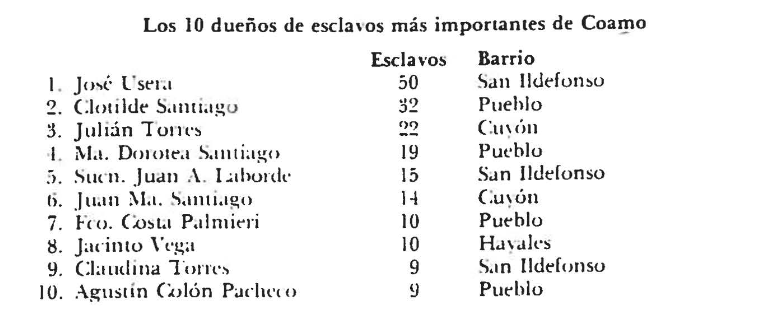
Source: Ramón Rivera Bermudez, Coamo: Notas para su historia (San Juan, Puerto Rico: Oficina Estatal de Preservación Histórica, 1983), p. 77, re: Ten most important slave owners in Coamo; “Notas para su Historia-Municipios de Puerto Rico–1980s,” The Rutgers Puerto Rico Archival Collaboration (PRAC) (https://prac.rutgers.edu/historias-de-los-pueblos-1980s/: accessed 28 March 2026).
You can also see that a list of the 10 most important slave owners was included which listed their name, how many slaves they had, and what barrio they lived in. This is important for people who have ancestors that were enslaved in Coamo. Also, just because their name is not listed here does not mean they cannot be found. Studying notarial records and the 1872 slave census will help to pinpoint where and when one of your ancestors may have been enslaved.
I highly recommend taking a look at these books to learn more about your ancestor’s town of origin. Unfortunately for me, since each of my great-grandparents was from a different town I have a lot of reading to do ! However, this helps me to better understand genealogy on the island better as a whole and so I am not too upset about that.
And yes, the books are written in Spanish, I am not sure how good translating technology works with older copies of things like this but it’s worth a try if you have experience doing that. Since the books have OCR technology, you should be able to copy and paste sections of the book (I tried it in two separate books and it worked!).
Happy hunting (and learning!)
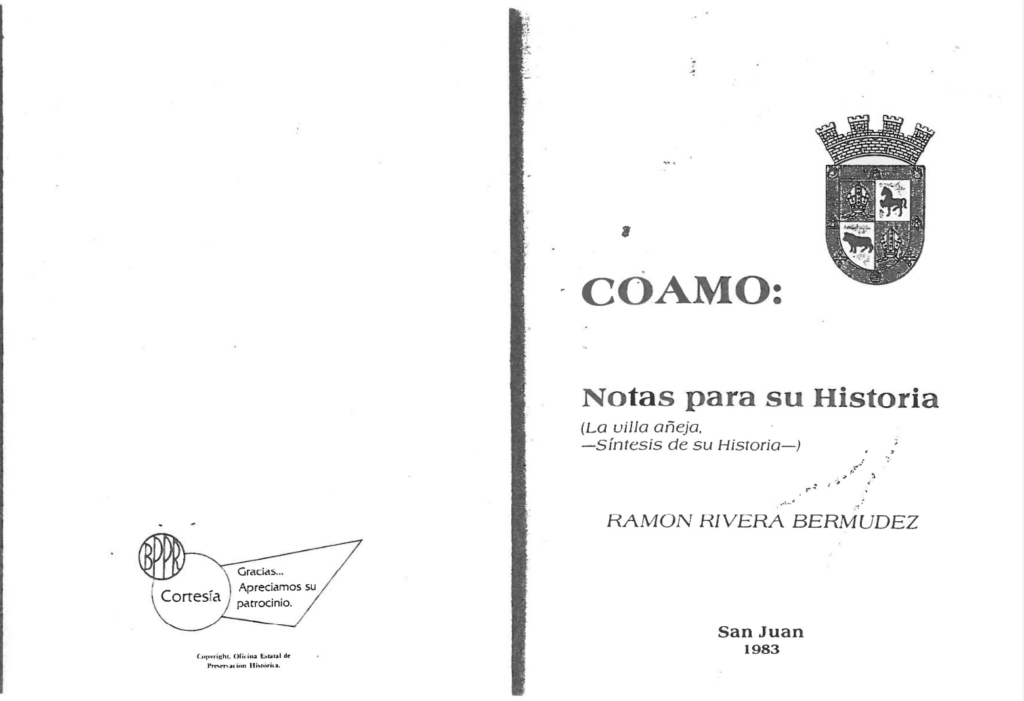
Cover Image: Ramón Rivera Bermudez, Coamo: Notas para su historia (San Juan, Puerto Rico: Oficina Estatal de Preservación Histórica, 1983); “Notas para su Historia-Municipios de Puerto Rico–1980s,” The Rutgers Puerto Rico Archival Collaboration (PRAC) (https://prac.rutgers.edu/historias-de-los-pueblos-1980s/: accessed 28 March 2026).