
This summer I decided to take a hiatus from posting. Though I thoroughly enjoy posting, life has gotten busier and busier. Between work, classes, and being a father of a very mobile baby, a lot of things end up on the back burner. So I decided to take some time off as to not burn myself out. However, I did want to pick back up now that school session is on it’s way (I was a teacher by trade, so an academic calendar of life makes sense to me).
Recently, I got the chance to help a Puerto Rican genealogical society digitize some records so I wanted to post about that since it’s still fresh in my head. Especially since it deals with records only available on the island!
The Need for Digitization
FamilySearch and Ancestry are great places to get your genealogy started; however, there are many resources out there that exist only on paper and can be found nowhere online. These includes records in both the Archivo General de Puerto Rico and Archivo Histórico Diocesano — both archives which I have had had the pleasure of visiting. However, recently the director of the Archivo Diocesano in San Juan has retired and therefore an opportunity opened up for preserving these documents. This is where the Sociedad Puertorriqueña de Genealogía (or SPG) stepped in. The goal was to digitize the probanzas de soltería and the dispensas de consanguinidad which were held by the Archivo Histórico Diocesano and can not be found anywhere else.
What Are These Records?
Here’s a quick breakdown of the two record sets which are currently being digitized.
- Probanzas de Soltería – Documents which proved that the bride and groom were single and free to marry. These were mainly useful for people of foreign origin in Puerto Rico who needed to prove that they were not married in their native country and that they were Catholic, i.e. my ancestors from Martinique and Guadeloupe who married in Vieques. However, I also learned that these records can also exist for couples who were from different towns! I.e. My second-great-grandfather who was from Vega Baja and my second-great-grandmother who was potentially from Utuado and who married in Manatí.
- Dispensas de Consanguinidad – These were records that allowed couples who were related to one and another the right to marry. Typically cousins needed permission from the church in order to marry and this was explained on the marriage record as a marriage of second, third, or fourth degree of consanguinity (these are the typical degrees I see).
Unfortunately, these records do not extend far back to the earliest years of Puerto Rican history. Most begin in the mid-1800s. Similarly, it is possible that over time some have been damaged or simply lost. Therefore, getting these records digitized is important to Puerto Rican history!
A Call to [Genealogical] Arms!
The SPG has asked its members to volunteer when possible. Currently, there is a main crew that goes in almost daily to digitize; however, many hands make light work! Therefore, if you’re able to come in — even if just for a few hours — this could be a great difference as to how fast these records can be digitized!
Answering the Call!
Since I was going to be in Puerto Rico for a week on vacation, I decided to answer the call and to give some of my time to digitizing!
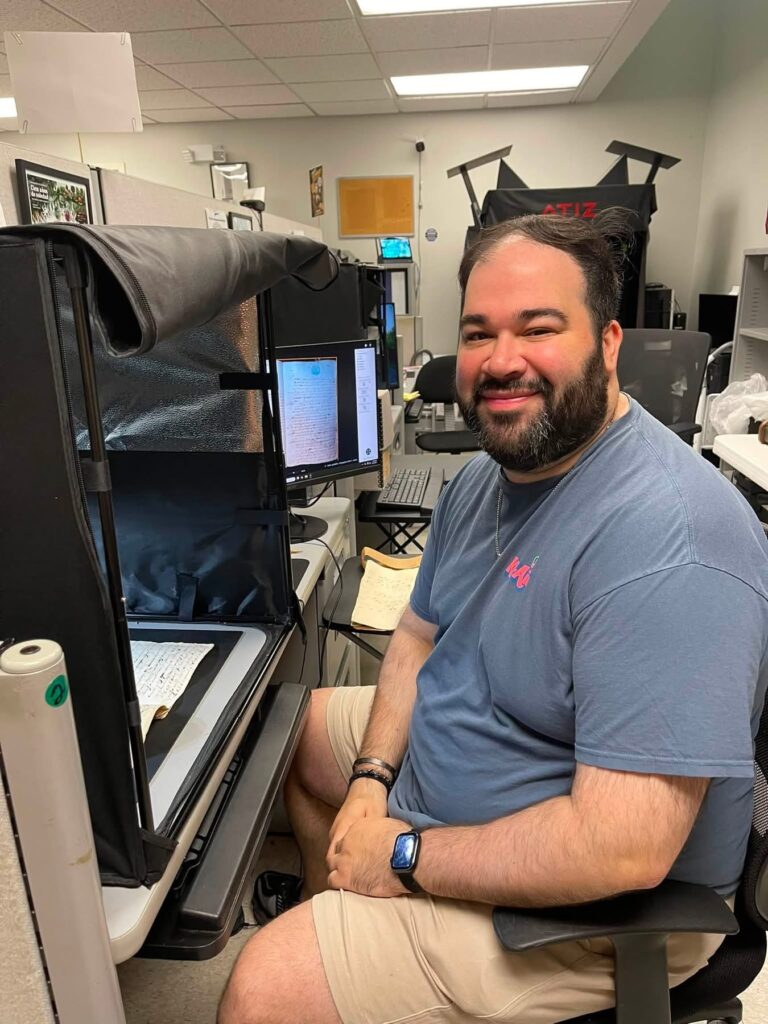
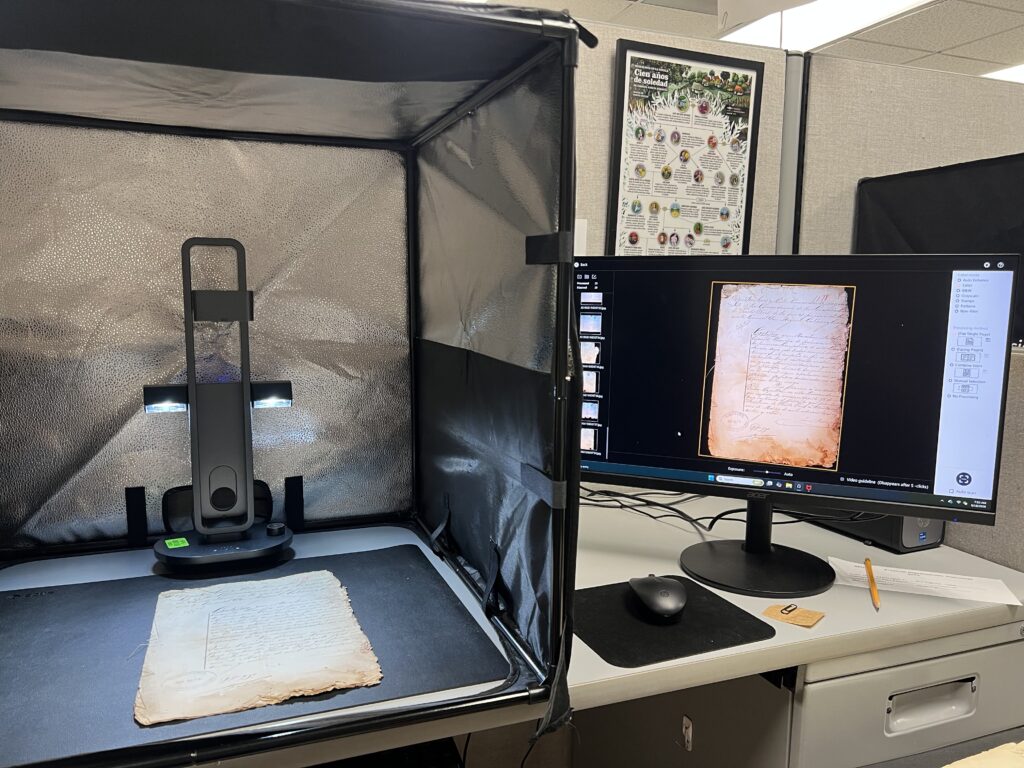
I went in a few mornings while on vacation and spent some days up to 4-5 hours helping to digitizing records — I focused on digitizing probanzas de soltería from Ponce and San Juan on a Czur machine which was exciting to use as well since it was my first time. In just those few days I was able to digitize over 1,500+ documents. That just goes to show you how one person can be an impact with a few days of volunteer work.
Since I was mainly focused on digitizing, I did not have time to read the records; however, I happened to glance over at one while I was waiting for the machine to take its photo and saw that it was the probanza de soltería for José Celso Barbosa (known as the father of the statehood movement in Puerto Rico) who married in San Juan in 1887. Since he was a native of Bayamón and his wife a native of San Juan, he needed to prove that he was free to marry.
Why This Work Matters
Puerto Rican weather can be very damaging to documents given the humidity, therefore time is of the essence when working on these records. Especially since many of them are already two hundred years old, things like mold, mites, and tears can render them useless.
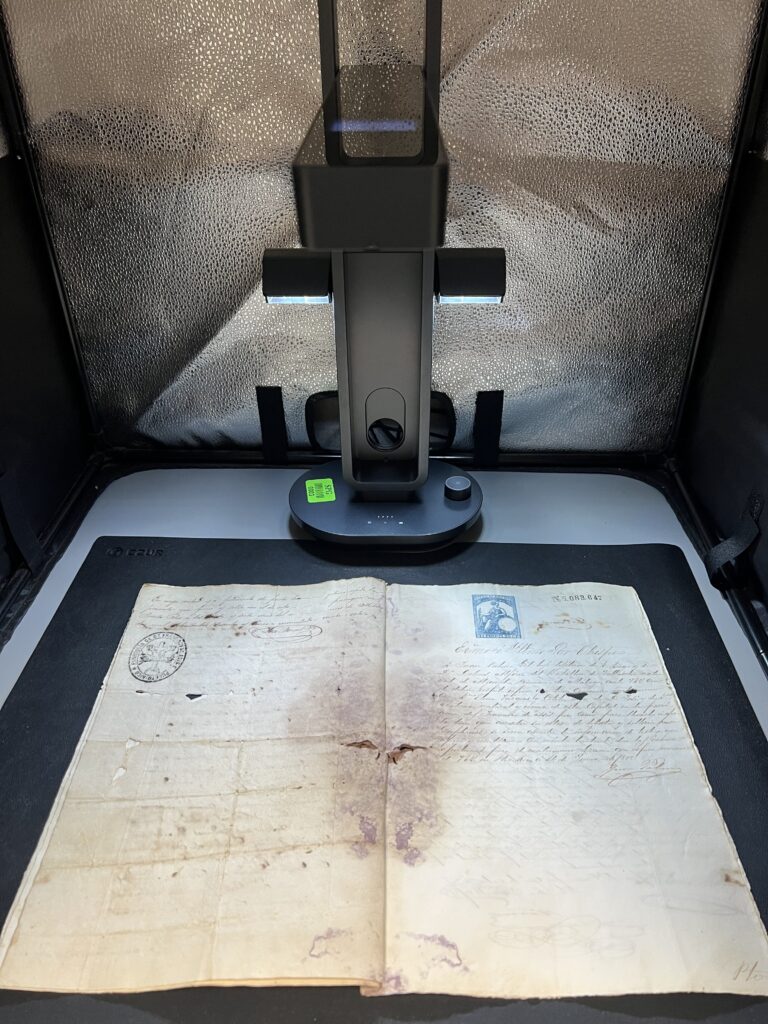
The document below was one of the more damaged that I worked with when it came to mold. Touching the paper, it felt damp and heavier than the rest. Luckily, much of the information is still visible. Other records I touched were almost falling apart with holes and tears across the pages. Digitizing these records will help to preserve as best as we can these records for future generations.
Sometimes it feels like a race against time to preserve these records. I can not even begin to imagine all of the records we have already lost to time and weather!
The Future of These Records
Many people wonder what will happen to the digitized records and if they’ll appear online. From my understanding, this is a complex answer. Though the genealogical society is helping to digitize these records, ultimately they do not own the rights to these records. What happens to them will ultimately depend on the religious entities in control of them. In the past, you could go to the Archivo Histórico Diocesano, request a box, and take photos of the records of interest. Now, we will have to see how this will work with them being digitized.
It is possible that they only remain visible to the public in person on the island. Though that is not the answer many of us want to hear, it is the reality of genealogy. This is also the case of records in Spain in places like Andalucía and Mallorca where I have gone to learn more about my ancestors.
We just have to respect the rules set out by them and hope that access remains fairly open to the public as it has been in the past. This can be cost prohibitive to many people, but unfortunately this may just be our reality. Once digitizing is complete, I imagine more information will be released on the decision taken and how one can access them.
Hopefully we will learn more soon about access to these records as I would love to use them to continue learning more about my ancestors that have these records.
I have sent a letter to the Archivo requesting a copy of the dispensation from the bishop of the marriage of two of my grandparents and one great grandparents. They need a dispensation because they were first cousins in the case of the Lago couple from Ponce and second cousins in the case of the Santiago‘s from Coamo and their parents also needed a dispensation. After further research I have found many other families like the Maldonado y Maldonado from Barrio Islote, Arecibo needing dispensation.
Gracias x compartir. Tremenda iniciativa de la Soc. Genealogía PR. Para hacer accesible información de nuestro pasado.