While reading the book The Common Wind: Afro-American Currents in the Age of the Haitian Revolution, I began thinking a lot about the role both enslaved and free people of color who spent their time working on boats played by passing along through word of mouth important information to their communities and others. The book focuses around the time before and after the Haitian Revolution and how other parts of the Caribbean handled the news and even the mobility of people across islands.
It then got me thinking about my 4th great-grandfather, Gustave Jean Charles, who was described as a carpenter, sailor, and lastly a coasting captain. He began his career on his home island of Terre-de-Bas, Les Saintes, Guadeloupe, later moving to Basse-Terre, Guadeloupe, and ultimately ending up in Puerto Rico.
I was also intrigued by the resources used throughout the book to speak about the social context of the time. Newspapers can play a major role in understand the social situations and mind frame of people then. I had not really explored Gustave’s role as coasting captain and wanted to learn more about that and see what newspapers could tell about this profession. This is what I will be focusing on in this post—learning more about his profession and when exactly he might have gotten involved in it.
Gustave Jean Charles
Here’s a quick rundown of my 4th great-grandfather Gustave Jean Charles’ life:
Born enslaved about 1821 on the island of Terre-de-Base, Les Saintes, Guadeloupe
Freed from slavery in 1832 along with his mother and three siblings
Married Françoise Jackson, his first wife, in 1843 in Terre-de-Bas
Moved to Basse-Terre on the mainland of Guadeloupe likely in the mid-late 1850s where he lived with his wife and where they ultimately bought a house
Found traveling to Martinique in 1864 — already was a coasting captain
His wife Françoise Jackson died from the cholera epidemic in 1865
Gustave married Julienne Malvina Lautin in Vieques, Puerto Rico, in 1869
Sold his sloop Cristina Aurora in to settle some debts
Traveled back to Martinique around 1877 where his daughter Marie Alexandrine (one of seven children) was born
Returned to Puerto Rico in the 1870s-1880s where he lived until his death in Ponce in 1891.
Knowing when and where Gustave lived is helping to understanding the movements of his life and gaining a better understand of the context of it as well.
Gustave's Professions
In tracking his life, it was also helpful to understand the different professions Gustave held throughout his life and when he ultimately became a coasting captain, known in French as capitaine caboteur.
The earliest mention of Gustave we have so far is through the marriage of his parents, Chaleau Jean Charles and Marie Lucie, in 1843. Gustave was recognized along with his siblings as the legitimate children of his parents, and therefore, he was listed as Gustave, 19 years old, a sailor. Gustave’s father Chaleau was listed as a proprietor and a carpenter. I do not know much about the proprietor part, especially since he had been previously enslaved—this is something else I need to explore. Likely, Chaleau learned the trade of carpentry as an enslaved person, potentially passed onto him through his father or other family members.
Source: État Civil [Civil Registry] (Terre-de-Bas, Guadeloupe), “Mariage [Marriage] 1843,” p. 3, no. 4, Chaleau Jean Charles and Marie Lucie, marriage, 4 September 1843; accessed as “Guadeloupe > TERRE-DE-BAS (LES SAINTES) > 1843,” browsable images, ANOM, (http://anom.archivesnationales.culture.gouv.fr/caomec2/ : accessed 27 August 2025).
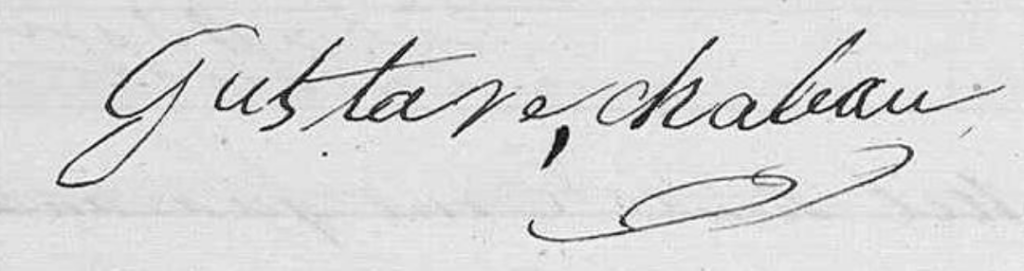
Gustave appeared just two months later in November 1843 marrying Françoise Jackson, a native of the island of Marie Galante. He listed himself as a sailor (marin). It is also important to note that Gustave knew how to sign his name, which meant that he had some level of literacy and education. We do not know exactly when he learned this skill, but he was freed young and therefore it is possible that he began to learn soon after he was liberated.
On 30 August 1860, Gustave appeared as a witness for the marriage of Louïson Bibrac and Julie Ademar in Basse-Terre, Guadeloupe. Louïson was 36 years old, who was registered on 23 September 1848, under number 587 (this refers to his freedom or acte d’individualité). He was a sailor who resided in Terre-de-Bas and was born in Vieux-Habitants, his parents were unknown. It was likely that Gustave knew the groom through their shared connection to Terre-de-Bas.
Gustave was listed as 44 years old, a coasting captain, and a resident of Basse-Terre. This documents helped to show that by 1860 Gustave was a coasting captain and that likely between 1843 and 1860 he gained this title.
Source: État Civil (Basse-Terre, Guadeloupe), “Mariages” pp. 25-26, no. 31, Louïson Bibrac and Julie Ademar, marriage, 31 August 1860; accessed as “Basse-Terre > 1860 > Mariage,” browsable images, Archives Nationales d’Outre-Mer (http://anom.archivesnationales.culture.gouv.fr/caomec2/ : accessed 3 July 2026). Image 27 of 37.
Another Clue - A Bill of Sale
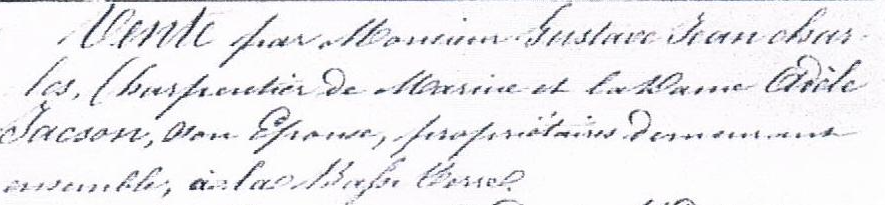
In May 1858 Gustave Jean Charles, a shipwright, along with his wife Adèle Jacson sold to Modeste Bidet, coasting captain, and Marie Louise, property on Rue du Domaine. We can see that Gustave was not yet a coasting captain, though he sold property to one! This helped to show that Gustave likely gained the title of captain between May 1858 and August 1860.
Coasting Captain Exams
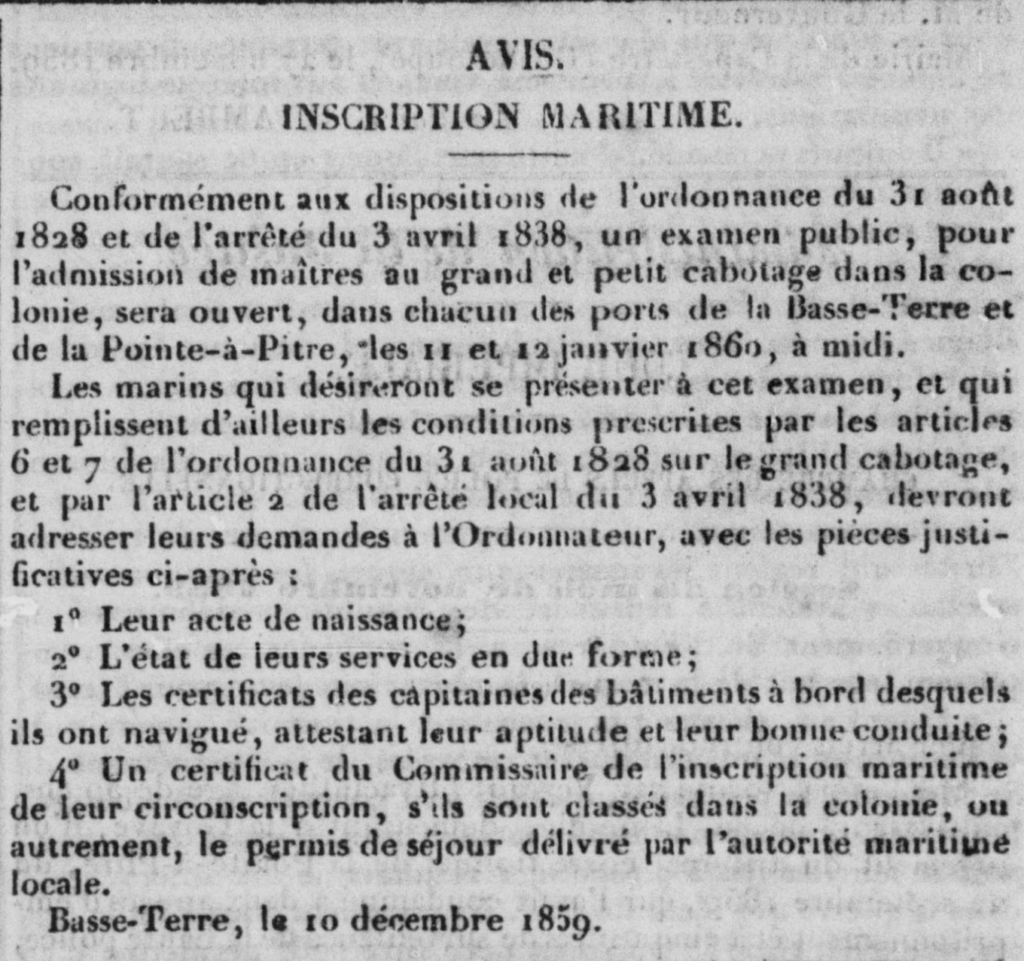
I decided to search for more information regarding the term cabotage around the time Gustave Jean Charles would have acquired the title of coasting captain. A search in the Digital Library of the Caribbean (dloc) website yielded various articles between 1858 and 1860 telling individuals who were interested that the public exam to become a maître au grand et petit cabotage (master in big or small coasting) was open in the ports of Basse-Terre and Point-à-Pitre, in this case for example, on 11 and 12 January 1860.
The sailors who wished to present themselves for this exam had to meet certain conditions set by the ordonnance (ruling) of 1828 and the arrêté (decree) of 1838.
Similarly, they needed to appear with: 1. their birth record 2. the state of the services 3. Certificates from the captains of the vessels on which they served, attesting to their competence and good conduct 4. A certificate from the maritime registration commissioner of their district, if they are registered in the colony, or otherwise a residence permit issued by the local maritime authority.
Source: “Avis Inscription Maritime,” Gazette Officielle de la Guadeloupe (Base-Terre, Guadeloupe), 20 February 1858, p. 85; Digital Library of the Caribbean (https://dloc.com/AA00095789/00241/images: accessed 3 July 2026).
This was a super interesting newspaper article to have found because it provided a bit more context to my 4th great-grandfather’s life without talking about him directly. Firstly, it shows that he needed to bring along with him certain proofs if he wanted to take this exam. Secondly, it shows that he needed to be in good standing and have good competence of maritime work. Thirdly, he needed to be registered with local maritime authorities.
Therefore, this leads me to believe that Gustave Jean Charles must have had all of these items for him to later become a coasting captain. We also know that he achieved the title of maître because he was referred to as this in his daughter’s birth record in 1878 in Martinique.
Source: État Civil (Saint-Esprit, Martinique), “Naissances” pp. 35-36, no. 119, Marie Alexandrine Jean-Charles, birth, 4 March 1878; accessed as “Saint-Esprit > 1878 > Tous Actess,” browsable images, Archives Nationales d’Outre-Mer (http://anom.archivesnationales.culture.gouv.fr/caomec2/ : accessed 3 July 2026). Image 37 of 138.
Balandra Cristina Aurora
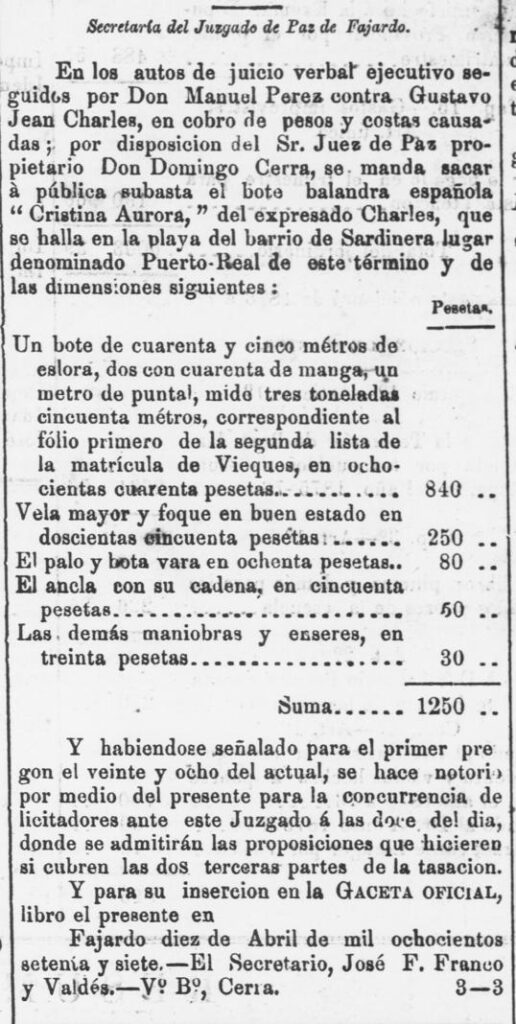
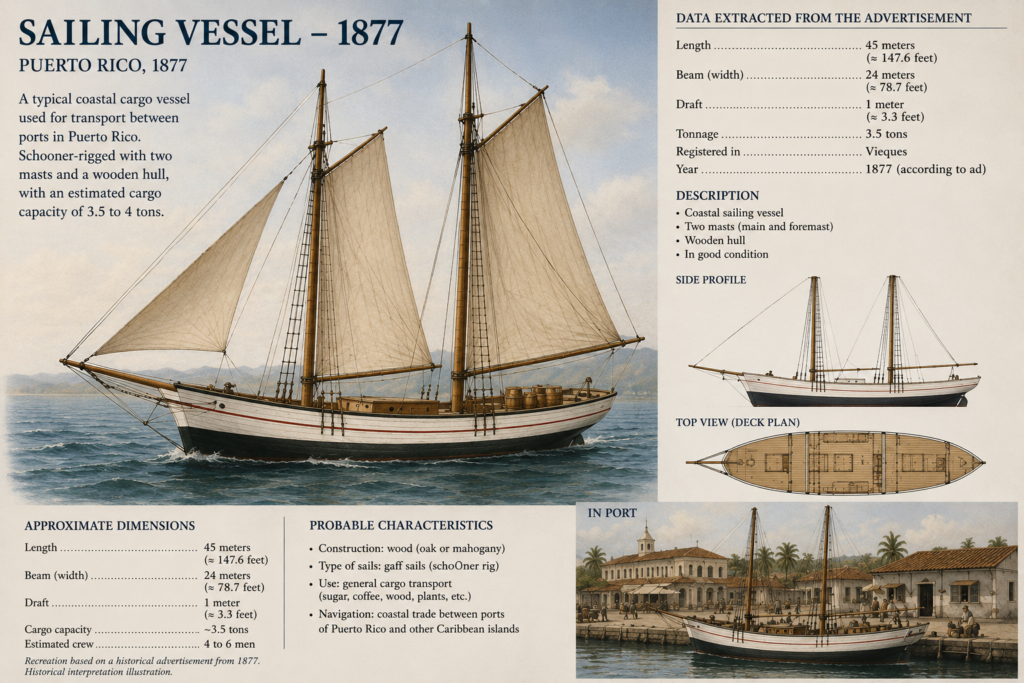
We also know that just before Maria Alexandrine’s birth, Gustave had sold a sloop in 1877 in Puerto Rico by the name of Cristina Aurora. A description of the boat was added in the newspaper as well as where the boat could be found (Sardinera, Fajardo) and who came forward (Manuel Pérez) against Gustave Jean Charles.
Source: “Secretaría del Juzgado de Paz de Fajardo,” Gazeta de Puerto Rico (San Juan, Puerto Rico), 21 April 1877, p. 3; Library of Congress: Chronicling America (https://www.loc.gov/collections/chronicling-america/about-this-collection/: accessed 3 July 2026).
With the help of ChatGPT and power of AI we have more or less of an idea of what the sloop would have looked like. This is amazing to have because for me, imagining dimensions is more a visual thing than a descriptive one. So having this rendered image allows me to better understand what type of ship Gustave would have had before it went on sale.
Source: ChatGPT (OpenAI, GPT-5.3), “Balandra Cristina Aurora” newspaper article (rendered image), digital image created 25 June 2026; “Secretaría del Juzgado de Paz de Fajardo,” Gazeta de Puerto Rico (San Juan, Puerto Rico), 21 April 1877, p. 3; Library of Congress: Chronicling America (https://www.loc.gov/collections/chronicling-america/about-this-collection/: accessed 3 July 2026).
Where to Next ?
My next area of exploration would be the Archives in either Guadeloupe or in Aix-en-Provence, France to see if there are any records tied to maritime life in Terre-de-Bas and Basse-Terre. Potentially there we can find either a matriculation for Gustave as a sailor or even when he passed his coasting captain exam. Since Gustave was a freed man, what would he have been doing as a coasting captain? Possibly trading?
Similarly, Gustave likely needed a probanza de soltería to get married in Puerto Rico. If this record still exists, then it’s possible that there is a copy of his birth record (that is, if he presented one). Finding this record may help to provide more information on when he was born as currently I don’t have that information.
Similarly, learning more about the ordonnance (ruling) of 1828 and the arrêté (decree) of 1838 could potentially provide more information about the job of a coasting captain and what other conditions someone needed to meet.
There is always something new to find and learn! Excited to continue learning more about Gustave and his life as a sailor and coasting captain.
Cover Photo Source: ChatGPT (OpenAI, GPT-5.3), “Balandra Cristina Aurora” newspaper article (rendered image), digital image created 25 June 2026; “Secretaría del Juzgado de Paz de Fajardo,” Gazeta de Puerto Rico (San Juan, Puerto Rico), 21 April 1877, p. 3; Library of Congress: Chronicling America (https://www.loc.gov/collections/chronicling-america/about-this-collection/: accessed 3 July 2026).
1 thought on “Ahoy! Exploring Gustave Jean Charles’ Life on the Sea”
Angel Torres Sanchez
Muy interesante! Buenas ideas de metodos y recursos de busqueda de informacion. Le deseo otra buena busqueda en los archivos en Francia y Guadalupe! Gracias x Compartir




Muy interesante! Buenas ideas de metodos y recursos de busqueda de informacion. Le deseo otra buena busqueda en los archivos en Francia y Guadalupe! Gracias x Compartir